
Written by Shira Goren for Cheryl Simon’s Film Theory course. TW: mention of r*pe.
Rosemary’s Baby, directed by Roman Polanski in 1968, is a psychological horror movie that discusses themes such as paranoia, satanism, and women’s liberation. It deals with the story of a young woman named Rosemary who moves to New York with her husband Guy, a struggling actor. Upon moving in, Rosemary falls pregnant and the couple becomes very involved with an elderly couple next door, the Castavets, who seem well-intentioned, but very imposing, especially on her pregnancy. As the story goes on, her pregnancy becomes more and more difficult for her. As she reaches out for help from her trusted friends they either die, or she is restricted from seeing them, becoming more isolated and distressed. She begins to suspect that her husband and the Castavets are dealing in witchcraft against her and her unborn child, and she must fight for her and her baby’s life all while living in a society that is actively working against her and her independence. The movie culminates in the baby being Satan’s child. In this essay, I would like to explore the male gaze that is continuously exemplified in the film, in the way that the movie represents and treats Rosemary, and how through this lens, the true horror of the movie becomes the female condition, rather than its satanist undertones. The true fear of the film is not the satanic nature of it, or the dealings of witchcraft, but the lack of bodily autonomy and credibility given to women of this time due to heteropatriarchal ideas.
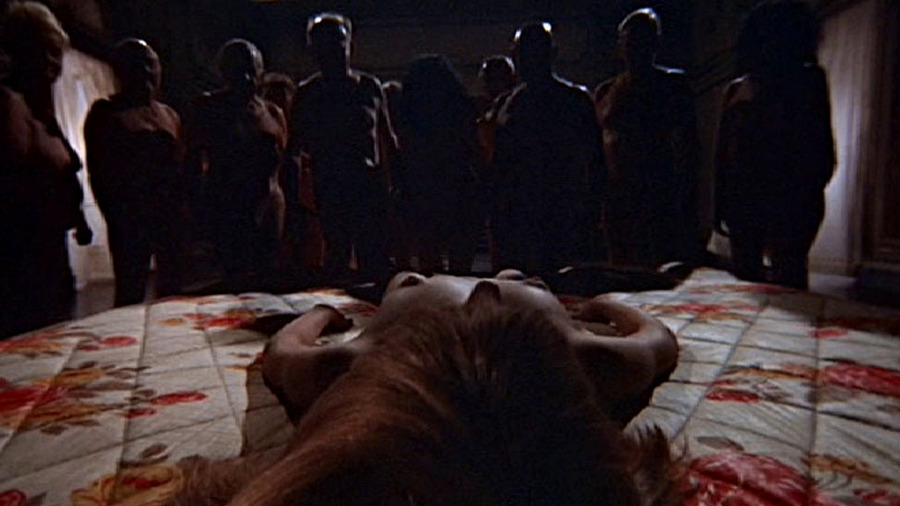
In my discussions of the male gaze, I will be delving beyond simply the aspects of sexuality and how Rosemary is presented as a sexual object, but also how she interacts with social dynamics and noting the power imbalances that occur between her and her male counterparts. In Feminism Is for Everybody: Passionate Politics by bell hooks, she states: “Ultimately feminist interrogations of sexuality [are] all tied to a question of power” (hooks 88). So to understand how Rosemary falls victim to the male gaze, we must observe her not only in her sexuality, but in the constant instances where she is made powerless, lacking, and submissive. One of the first glaring examples we can observe is the way Rosemary falls pregnant; she is drugged into sleep and raped by what she assumes to be her husband. Even as her nude body is shown on screen, the sense given to the viewer is not one of lust, or desire, and even if the viewer, fallen under the influence of the male gaze, experiences lust or pleasure in this depiction, they are constantly shamed for it throughout the movie, as Rosemary’s pain and mistrust grows following the incident and through her disturbing dreams and moments of consciousness during the rape. The male gaze is a direct enemy of our protagonist, and the viewer is meant to be left feeling shameful, disgusted. While we do find out at the end that it was Satan that had raped her, for all we know at the time, Guy has raped her in her sleep, and the way that the movie addresses this is all too calm, with Guy even saying it was “kind of fun, in a necrophile sort of way”. And of course he’s calm about it, because for all he knows, he has every right to a woman’s body, which brings me to the concept of gender fatalism; the idea that from sex, gender (and all of its constructed ideas) follows. As Sara Ahmed says: “boys will be boys, [uttered] with an intonation of forgiveness: an unruliness explained as boys being boys; aggression, violence even”, and in contrast “to become [a] girl is to learn to expect such advances; to modify your behavior in accordance . . . because gender fatalism has already explained the violence directed against you as forgivable and inevitable” (25-26). No wonder Rosemary doesn’t fight back at first, rather she sits down and takes it; she takes the weird treatments from the Castavets that make her frail and sickly, she accepts the constant invasion of her bodily autonomy, she accepts her infantilization as someone who is deemed incapable of making health decisions for herself, she accepts her lowly position as “wife”, as “woman”, because it is evident and certain that there is no other conceivable option; she is a woman. Yet, despite Rosemary’s lack of help of understanding, we as the viewer, through formal techniques as well as storytelling techniques, recognize the horror of the movie, well before its supernatural elements come into play. We, as viewers, sense the injustice and isolation of being a prisoner in one’s own body, stripped of self-advocacy, of credibility, of rights. No one understands this pain better than a woman, for it is not the devil that Rosemary is fighting against for the majority of the movie, rather it is the heteropatriarchal gaze attributed to her womanhood that keeps her trapped. As Sara Ahmed aptly puts it: “Violence becomes instruction when it is accompanied by a narrative, an explanation” (24). Through the concepts of gender fatalism and phallocentrism, all tied into a neat bow of the male gaze, Rosemary becomes a victim of a world instructed to hate her, instructed to have its way with her. Through examining the male gaze and how it repeatedly fails and harms our protagonist, we, as spectators, feel the injustice and fear of Rosemary as if it was our very own. As viewers, we become victims of the male gaze and its scrutiny, and we think of feminist ideas; that Rosemary should do what she wants, that she should get an abortion, that she should be able to say no to her husband, that she should have a right to her own autonomy. Ahmed says: “Feminism helps you to make sense that something is wrong; to recognize a wrong is to realize that you are not in the wrong” (27). As Rosemary discovers this as she fights for herself after being repeatedly subjected to heteropatriarchal ideas, we as the viewer follow suit. Thus, Rosemary’s baby, despite being all about the male gaze, forces us to become feminist thinkers as we are forcefully subjected to the female condition firsthand.
WORKS CITED
Ahmed, Sara. Living a Feminist Life. Duke University Press, 2017.
Hooks, Bell. Feminism Is for Everybody: Passionate Politics. South End Press, 2000.
Polanski, Rroman, director. Rosemary’s Baby. Paramount Pictures, 1968.
 SUBTEXT JOURNAL