Written by Neyla El-Euch for Lex Milton’s Explorations in Cinema and Communications course.
The desire to convince others of one’s opinions has been an integral part of human communication across time. However, this has resulted in the dissemination of propaganda: the spreading of biased and often misleading information promoting particular political agendas and ideological viewpoints (Milton). Examples of this phenomenon are found throughout history, in contemporary society, as well as in fiction, which mirrors the former two. In the Harry Potter universe, in Nazi Germany, and throughout Donald Trump’s campaigns, propaganda and disinformation are used in similar contexts, are spread by comparable means, and yield resembling outcomes, revealing truths about human nature.
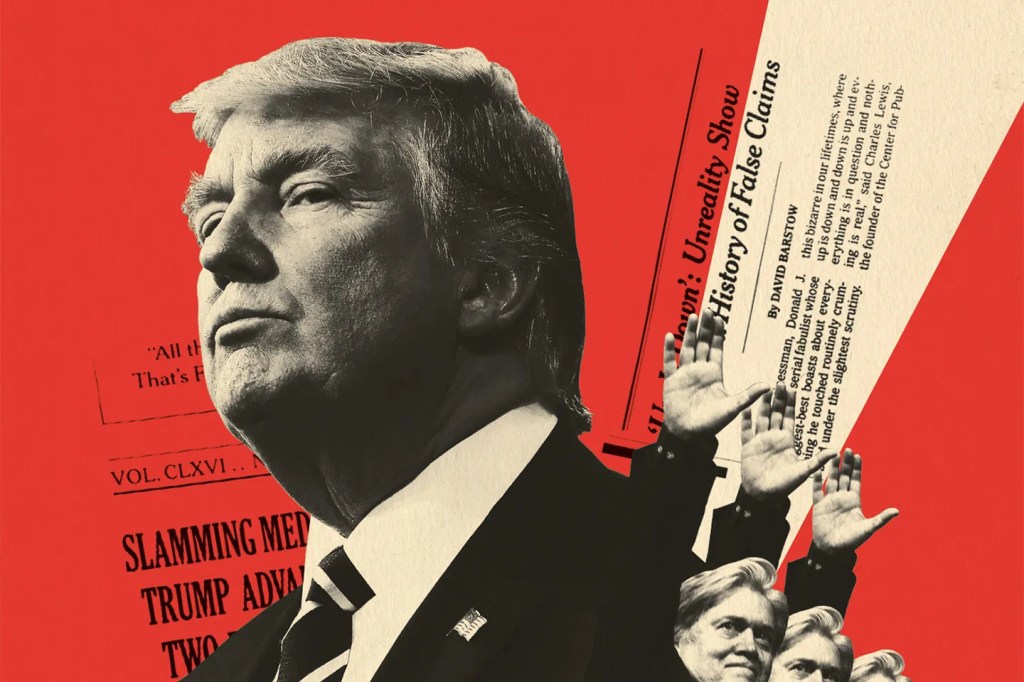
Firstly, in all three sources, there are similar contexts and motivations propelling the use of disinformation. In Harry Potter, the British magical government denies and manipulates the truth about the return of the dark wizard, Lord Voldemort. The Minister of Magic, not wanting to face the “terrifying truth” of Voldemort’s reemergence and the threat it poses after fourteen years of peace, resorts to spreading disinformation and malinformation to project an image of control, power, confidence, and security in the public eye in order to maintain his position and reputation (Goldenberg; Carlo). This facilitates the infiltration of Voldemort’s forces into the Ministry and his eventual takeover, upon which he continues the Ministry’s legacy of propaganda, this time using it to promote his own discriminatory ideologies through official means. Prior to the seizing of power by the Nazi party, Adolf Hitler began as “a little known extremist” in a time of “political uncertainty and recurring economic upheavals” in the democratic German Weimar Republic after World War 1 (“Making a Leader”; Montreal Holocaust Museum). He used propaganda based on disinformation and malinformation in his early campaigning days to feed off of and encourage the dissatisfied populace’s pre-existing biases, “nostalgia for the past” , and fears for the future, giving them false hope and someone to blame for the everyday hardships they were experiencing (“Making a Leader”; Montreal Holocaust Museum). This gained him mass support, allowing him to initially take power legitimately, then maintain it through dictatorship, and achieve his goal of empirical strength and genocide (Russo). Similarly, in his 2016, 2020, and 2024 presidential campaigns, Donald Trump spread disinformation and lies targeting specific people or groups for the growing economic and social issues, like rising living costs and inflation rates, that were plaguing the United States. He took advantage of and manipulated the American population’s worries about the economy, their national identity, their freedom, and the future in order to further polarization and gain public support, allowing him to take power twice and pass self-benefiting policies – such as tax breaks for the wealthy (Seitz-Wald, et al.; Barrow). The similarities in contexts and motivations behind Voldemort, Hitler and Trump’s use of propaganda reveals a pattern: one in which fringe groups led by egotistical individuals eventually seize legitimate power due to their use of propaganda, manipulating the population’s pre-existing fears and anxieties in uncertain times – especially those of political instability – all with the clear intent of advancing the leader’s personal goals for power, domination, and ideological control. This can teach us that, in times of crisis, we are particularly susceptible to propaganda, both from legitimate sources as well as extremist groups, and that we should be wary of being swayed, lest these two become one and the same.

Secondly, similar methods, techniques, and mediums are used to create propaganda and disseminate it in all three sources. For example, the use of scapegoating and othering, the distortion and exaggeration of truth through slanted language, the abuse of government power and the education system, and the creation of a cult of personality are rampant across a variety of media and mediums in all three sources. In Harry Potter, The Minister of Magic uses “all his power, including his influence at The Daily Prophet [the government-controlled wizarding newspaper], to smear anyone who claims The Dark Lord has returned”; he additionally places blame for the crimes perpetrated by Voldemort on a previously wrongly-convicted criminal, thus diverting public attention from the true threat and setting an agenda (Goldenberg). He also tightens the Ministry’s influence at Hogwarts, the wizarding secondary school, to implement a curriculum that aligns with his malinformation. After his takeover, Voldemort himself continues to use governmental and educational channels to spread his ideologies, as seen through the creation of the Muggle-Born Registration Commission, an organization that monitors the actions and restricts the liberties of wizards who do not have magical ancestry, and its dissemination of leaflets professing the “dangers” that these individuals “pose to a peaceful pure-blood society” (“Propaganda”). This is reminiscent of the tactics used by Nazi Germany. Nazi propaganda was systematically and deliberately enforced by the Reich Ministry of Public Enlightenment and Propaganda, which controlled all “schools, universities, film, radio, and propaganda” (“Ministry of Propaganda and Public Enlightenment”). In Nazi propaganda, Jews and other minorities were blamed for Germany’s defeat in the First World War and its subsequent economic issues, and were dehumanized and vilified through the perpetuation and heightening of pre-existing derogatory stereotypes, especially in visual media. This propaganda infiltrated all spheres of society to ensure maximum influence, from films such as the heavily biased and antisemitic documentary The Eternal Jew, to posters associating Jews with communist symbols, to caricatures in newspaper cartoons, to family board games in which players “scored points by chasing the Jews out of Germany”, to children’s school textbooks rife with disinformation (Montreal Holocaust Museum). Hitler further used propaganda to cultivate a “public persona” that depicted him as “a saviour”, to glorify the Aryan race, and to unite his followers through slogans and symbols (“Making a Leader”). Comparably, Donald Trump has also used fear-mongering and othering techniques, such as by slandering his political opponents and referring to them as the “enemy from within”, and by repeating racist rhetoric against immigrants throughout his campaign rallies and presidential speeches, such as by claiming that they are “poisoning the blood of the nation” (Granoff). He has also utilized the power of semiotics to unite his followers and grow his cult persona, demonstrated through the popularity of his “Make America Great Again” slogan and the widespread dissemination of his mugshot and post-assassination-attempt photograph. Although digital media has changed the political landscape of the Trump era compared to 1930s Germany or the non-technological wizarding world, Trump’s inflammatory Tweets and Truth Social posts mirror traditional and tangible media such as leaflets and posters in their short, easily disseminated nature. Comparing the means and mediums used in these three sources reveals that although propaganda can take many forms, certain key features, such as its institutionalization, its prevalence, its disproportionate targeting of minorities, and its use of emotional appeal and inflammatory language, define the way in which political agendas and ideological viewpoints are spread. Furthermore, this proves that all channels of human communication can be corrupted and used to spread disinformation. Being more aware of these truths can help individuals and societies identify propaganda and improve our media literacy, especially as we navigate the ever-changing digital landscape.

Thirdly, the use of propaganda and disinformation in all three sources yields similar negative impacts and consequences, namely a threatened democracy, a misinformed populace, the targeting of minorities, the legitimization of discriminatory and prejudiced attitudes, the division of society, and the breeding of fear, suspicion, and anger. For example, in the Harry Potter universe, the Ministry of Magic’s denial of the truth of Voldemort’s return leaves “the general public . . . unaware and ignorant of his presence, making it easy for his operations to run smoothly and without interference”, as seen by the freeing of “several of his most loyal followers” from prison and the rise of unexplained disappearances (“Tom Riddle”). It also results in the social shaming and isolation of those who speak the truth. Under Voldemort’s rule, the discrimination against and persecution of those who oppose him or whom he deems undesirable is legalized, blurring the lines between the justice system and his self-appointed law enforcement. In Nazi Germany, the manipulation of public opinion validated thousands of people’s pre-existing prejudices, “inciting hatred” and creating a public attitude of “indifference”, acceptance, or support of “genocide” and autocratic rule (“Nazi Propaganda”). It is indisputable that “Nazi propaganda played an integral role in advancing the persecution . . . of Europe’s Jews”, leading to the deaths of 6 million Jewish people, the displacement of countless more, and a rise in antisemitism that can still be felt today (“Nazi Propaganda”; “How Many People did the Nazis Murder?”). Throughout Trump’s campaigns, his inflammatory and misleading rhetoric has been scrutinized for its propagation of hate and “contempt for the other side”, normalizing the use of slanted and derogatory language, emboldening extremism, and leading to a more politically and socially polarized society, the legacy of which is unknown to us (Achenbach). His claims that the 2020 election was “rigged” incited a riot, with “over 2,000 protestors . . . storm[ing] the Capitol . . . in hopes of overturning the election – . . . undermining the basis of . . . democracy” and illustrating the very real threats that arise when those in power twist the truth, spread conspiracy theories, and propagate fake news (Siebold). All these negative consequences, devastating in nature and scale, affecting both the functioning of major institutions as well as everyday people’s lives and livelihoods, demonstrate that the use of propaganda should not be taken lightly.
To conclude, propaganda and disinformation are used in similar contexts and with similar motivations, are disseminated by comparable means, and yield resembling consequences in the Harry Potter universe, in Nazi Germany, and throughout Donald Trump’s campaigns. These similarities reveal that propaganda is an effective method for self-interested leaders to gain and maintain power and spread their ideologies in times of instability, allowing them to manipulate the populace’s pre-existing fears and biases through a variety of techniques and mediums that are widespread, systemic, emotionally-charged, and divisive, leading to grave and destructive outcomes. The variety of sources compared suggests that no society or time period is immune to the influence of disinformation. However, learning from the lessons of history and fiction, we can recognize the situations that are susceptible to the use of propaganda, identify its key components, understand the gravity of its effects, and form a more aware society today.
works cited
Achenbach, Joel. “Science is revealing why American politics are so intensely polarized”. The Washington Post, Jan. 20 2024, https://www.washingtonpost.com/science/2024/01/20/polarization-science-evolution-psychology/
Barrow, Bill. “Here’s where Donald Trump stands on key policies ahead of his second administration”. PBS News, Nov. 2024, https://www.pbs.org/newshour/politics/heres-where-donald-trump-stands-on-key-policies-ahead-of-his-second-administration
Carlo, Andrea. “‘Harry Potter’ And Its Frightening Political Parallels: How We’re Living Through ‘The Order Of The Phoenix’”. Medium, Dec. 15 2018, https://andreacarlo. medium.com/harry-potter-and-its-frightening-political-parallels-how-we-re-living-through-the-order-of-the-148698d4
Goldenberg, Michael, screenwriter. Harry Potter and the Order of the Phoenix. Warner Bros. Pictures, July 11 2007.
Granoff, Jonathan. “Trump is repeating a history of propaganda, violence and hate.” The Hill, Nov. 5 202, https://thehill.com/opinion/campaign/4970904-trump-attacks-democracy/
“How Many People did the Nazis Murder?” United States Holocaust Memorial Museum. Holocaust Encyclopedia. https://encyclopedia.ushmm.org/content/en/article/ documenting-numbers-of-victims-of-the-holocaust-and-nazi-persecution. Accessed Nov. 30 2024.
“Making A Leader”. United States Holocaust Memorial Museum. Holocaust Encyclopedia. https://encyclopedia.ushmm.org/content/en/article/making-a-leader?series=1. Accessed Nov. 30 2024.
Milton, Lex. “Quiz F20204 Explorations Study Guide”. Explorations in Cinema Communications 530-113-DW, Nov. 18 2024, Dawson College. Google Slides presentation.
“Ministry of Propaganda and Public Enlightenment”. United States Holocaust Memorial Museum. Holocaust Encyclopedia. https://encyclopedia.ushmm.org/content/en/article/ministry-of-propaganda-and-public-enlightenment?series=1. Accessed Nov. 30 2024.
Montreal Holocaust Museum. Montreal. Information from various exhibit labels and panels.
“Nazi Propaganda”. United States Holocaust Memorial Museum. Holocaust Encyclopedia. https://encyclopedia.ushmm.org/content/en/article/nazi-propaganda?series=1. Accessed Nov. 30 2024.
“Propaganda”. Harry Potter Wiki, Fandom. Oct. 29 2024, https://harrypotter.fandom.com/wiki/Propaganda?oldid=1868409. Accessed Nov. 30 2024.
Russo, Paola. “Lecture on Nazi Germany”.History Local Program 585544-57, 2023-2024, Vincent Massey Collegiate. Lecture.
Seitz-Wald, Alex, Gomez, Henry J., and Korecki, Natasha. “How Trump won – and how Harris lost – the 2024 election”. NBC News, Nov. 8 2024, https://www.nbcnews.com/politics/2024-election/how-trump-won-harris-lost-2024-election-rcna178840
Siebold, Emma. “The Rise of MAGA and political extremism”. The Berkeley Beacon, April 17, 2024, https://berkeleybeacon.com/the-rise-of-maga-and-political-extremism/
“Tom Riddle”. Harry Potter Wiki, Fandom. Nov. 25 2024, https://harrypotter.fandom.com/wiki/Tom_Riddle?oldid=18741539. Accessed Nov. 30 2024.
 SUBTEXT JOURNAL