Written by Mikaël Bédard for Cheryl Simon’s Film Theory course.
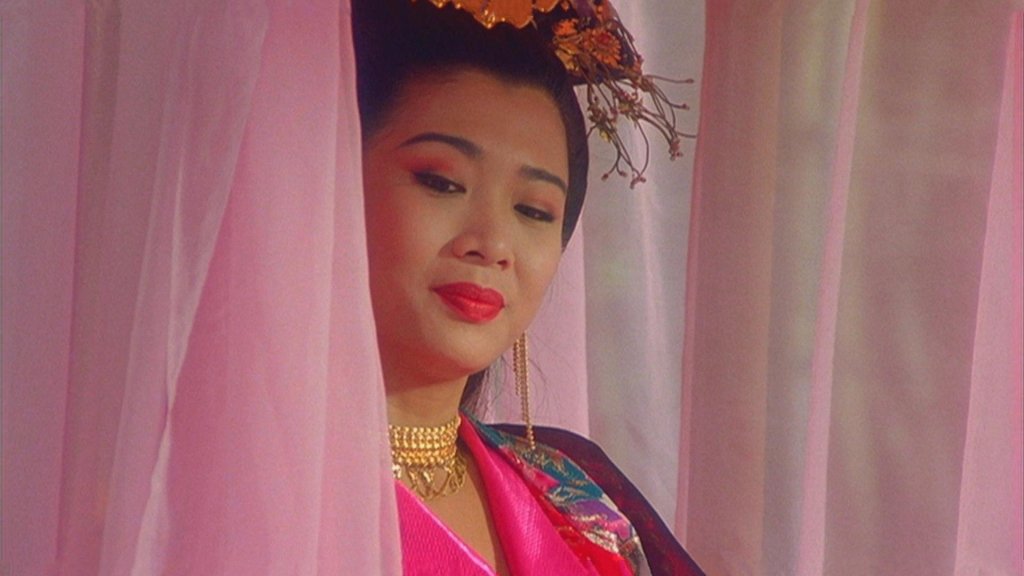
In the 1996 film Viva Erotica, an out-of-work film director agrees to make a Category III/soft-core porno to make ends meet. He is asked to be more “Wong Jing than Wong Kar-wai”; in other words, he is asked to compromise his artistic integrity to make a living. Viva Erotica serves as the perfect encapsulation of the Category III era by capturing the spirit, cultural craze, and industry dynamics of 1990s Hong Kong cinema, even though it differs from the stereotypical Category III film in many ways. The film is a self-aware deconstruction of the genre it depicts. In fact, the film the director is creating within it leans heavily into the stereotypical tropes of Category III cinema – it’s filled with many defining traits of the genre: nudity, gratuitous sex scenes, and melodrama. As seen in Viva Erotica, Category III cinema raises an important question: can transgressive art challenge societal norms without sacrificing artistic value?

Category III films contain graphic violence, depictions of drug use, strong sexual scenes, and pervasive coarse language. It is a classification within Hong Kong’s film rating system, introduced in 1988 as part of an effort to regulate and censor cinema in response to a growing prominence of explicit movies. Contrary to what one might assume, Category III movies are an established, accepted part of Hong Kong cinematic culture. In fact, it is its transgressive and offensive nature that acts as a selling point. Category III can be misinterpreted as a genre or a style. This is not the case. It is a vast categorization system that includes everything from exploitative works like The Untold Story and Ebola Syndrome, to erotica such as Sex and Zen, and even auteur driven dramas like Wong Kar-wai’s Happy Together. What these films have in common is a strong sense of transgression: they rethink and subvert styles and genres popular in Hong Kong cinema. Category III films occupy a fascinating space in Hong Kong cinema, standing as both a provocation and a mirror to social norms. They create an environment where audiences are forced to confront the boundaries of their comfort zones. They consist of excess, graphic violence, sexuality, and melodrama, while simultaneously exposing the hypocrisies and contradictions within the society they habit.



While Category III films can contain great artistic value and social commentary, the truth is that a significant portion of these works can be said to lack genuine artistic merit. Many films in this classification rely entirely on shock value without meaningful narrative depth or thematic exploration. These are movies conceived as commercial products rather than art pieces. This approach results in formulaic productions that fail to engage with complex subjects. The abundance of low budget B-movies in the classification overshadows more artistic works. However, it is also important to consider that the existence of such films has broadened the scope of artistic expression, challenging what is considered acceptable in mainstream media. Category III films, in their best moments, serve as a vital contrast to conventional cinema, providing a platform to confront uncomfortable truths and provoke meaningful discourse. They demonstrate how cinema can be both a reflection and a reaction to societal pressures, making them an indispensable part of Hong Kong’s cinematic legacy. Despite the provocative nature of Category III cinema, it reflects the anxieties and cultural shifts of Hong Kong during the 1980s and 1990s. The post-colonial period leading up to 1997 brought with it uncertainty about identity, freedom, and expression. Category III films represented these tensions by exaggerating those societal fears to the extreme. In a sense, the graphic and exploitative served as a platform to explore issues such as corruption, moral decay, and the fragility of social structures. A way of creating Category III films without compromising artistic value is by using the medium as a meta-commentary on entertainment itself. Pushing the boundaries of social acceptance and taboos might have artistic value on itself seeing how it questions the relationship between the viewer and the content. In this context, the act of transgressing is not solely for shock value; it becomes a form of cultural critique.
In conclusion, Category III filmmaking stands as a testament to both the power and controversy of transgressive cinema. While these exploitative works challenge societal norms, it is not without its share of drawbacks. Their explicit content risks reinforcing stereotypes and overshadowing deeper narrative and artistic intent. This dilemma between purpose and provocation raises an interesting question: does the intention of breaking taboos enhance the cultural value of cinema, or does it simply undermine its ability to connect meaningfully with its audience?
WORKS CITED
“Category III Films in Post-Handover Hong Kong: Excessive Violence and Its Containment in Weiduoliya yi hao and Chuji Jing Jing Chang.” JCMS: Journal of Cinema and Media Studies, vol. 62, no. 2, Winter 2023, pp. 31–55. Michigan Publishing, https://doi.org/10.1353/cj.2023.0003.
Davis, Darell W., and Yeh Yeuh-Yu. “Warning! Category III: The Other Hong Kong Cinema | Film Quarterly | University of California Press.” _University of California Press_, 2001, online.ucpress.edu/fq/article-abstract/54/4/12/41583/Warning-Category-III-The-Other-Hong-Kong-Cinema?redirectedFrom=fulltext.
Williams, Anthony. “Hong Kong Social Horror: Tragedy and Farce in Category 3.” Post Script, vol. 21, no. 3, Summer 2002, Post Script, Inc., pp. 6,595.
Woods, Allen. “Category III Films and VCDs: The Failure of Deterrence in the Copyright Ordinance of Hong Kong.” Vanderbilt Journal of Transnational Law, vol. 36, no. 3, May 2003, pp. 1073-1112. HeinOnline.
 SUBTEXT JOURNAL