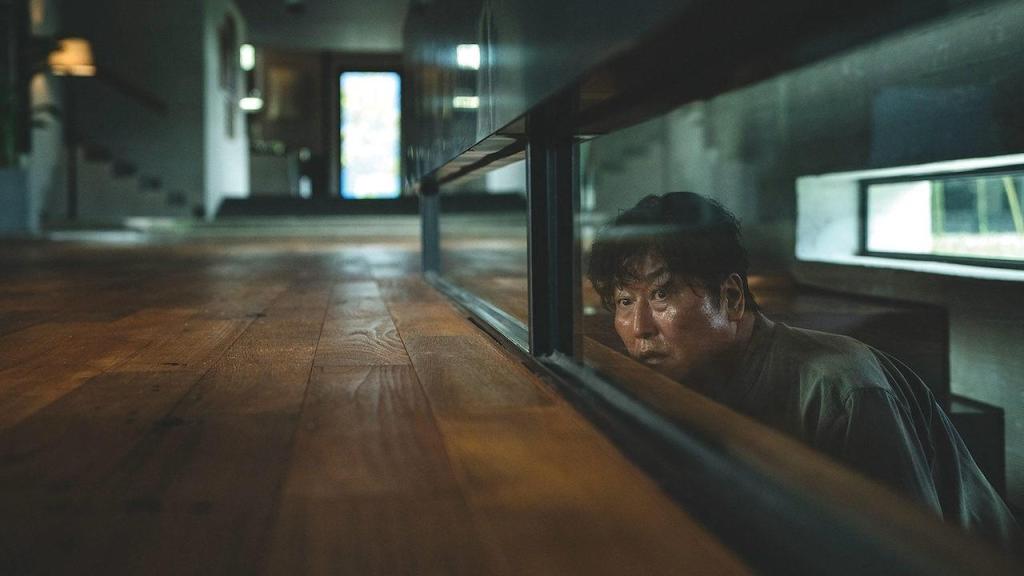
Written by Lily Greenspoon and Gabriella Kouri for Magdalena Olszanowski’s Cinema Styles course
Described as “eat the rich movies,” Bong Joon-ho’s 2019 film Parasite and Mark Mylod’s 2022 film The Menu have been praised for their commentary on class consciousness: exploring anti-capitalism, and highlighting the inequalities that exist between classes, along with the problems that arise from these disparities. Both films explore the relationships between “those who take,” represented by the rich, and “those who give,” represented by the working class.
Parasite begins with a close-up of the Kim family’s socks hanging from the ceiling, and Ki-Woo and Ki-Jung, the children, running around trying to connect to someone else’s wifi. As the film progresses, the Kims, one by one, con their way into getting jobs at the Park residence. Ki-Woo becomes their tutor, his sister, their art therapist, his father, their driver, and his mother, their housekeeper. Thus, the Kim family represents the givers. When they discover that the old housekeeper’s husband is still living in the Parks’ basement to avoid debt, chaos ensues. While it is tempting to view the Kim family or the man in the Park’s basement as parasites, infiltrating and profiting off of the rich’s home and wealth, the film does not serve to criticize the selfishness of the poor, but rather the unfairness of capitalism. In this vein, the Park family, who profit off of capitalism, represent the takers.
Similarly, in The Menu, the chef Julian Slowik, his loyal workers, and sex worker Margot, are givers and the rich who “represent the ruin of [Julian’s] art and [his] life” are the takers (Mylod). Julian Slowik lured the rich guests to his island under false pretences and the promise of an unforgettable experience of luxurious dining. Little do they know, their deaths are an integral part of the night’s menu.
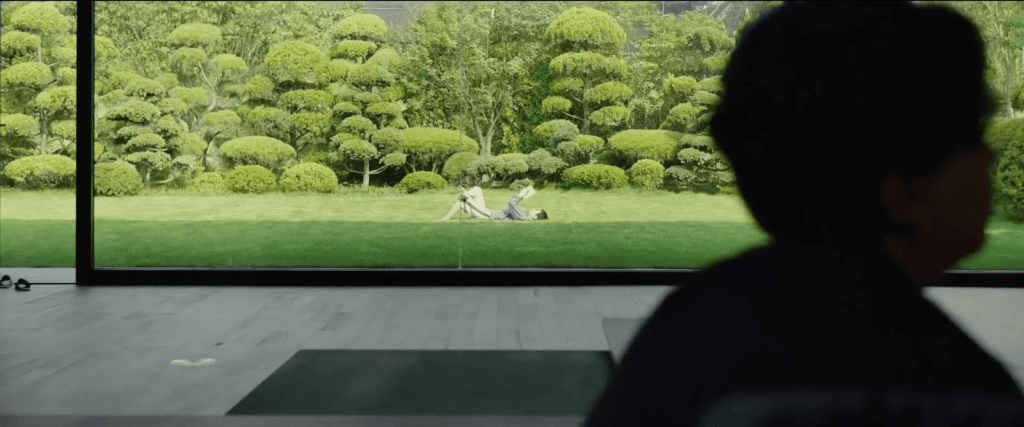
In terms of stylistic elements, color plays an important role in conveying meaning in Parasite. Green, for instance, represents envy and dissatisfaction. Noticeably, there is a contrast between the vibrant – almost fluorescent – grass on the Park’s property, and the Kim’s gloomy neighborhood. It is a nod to the expression “the grass is always greener on the other side of the fence,” with the Park’s home being on the other side of town. Furthermore, when the Kim’s house is flooded, the water in the house has a green tint to it. This represents the envy aimed at people in the upper class, like the Park’s, who do not have to worry about their houses being destroyed by rain (“Parasite – The Power of Symbols”).
Notably, the Kim’s semi-basement has a darker color scheme and lacks natural sunlight, a stark contrast to the Park’s home, which is full of light and white furniture. This is another integral element of the story which demonstrates their class difference – one home is on top of a hill with beautiful large windows and the other is almost entirely underground. That said, there is a noticeable shift in lightning at the midpoint of the film when the Kim’s discover there is a man living in the Park’s basement. There is a thunderstorm; the lightning and tone become dark and gloomy. This is an example of cinematic language – pathetic fallacy – being used to “tell” the audience that something bad is about to occur.
Similarly, lighting and weather play an important role in The Menu. In the dining room, there is an obnoxiously large window outlooking the water which acts as a backdrop for most of the film. The sun sets throughout the evening and, as the film progresses, it gradually gets darker, increasing the suspense and the tension between the wealthy guests – the takers – and those in the kitchen – the givers (Sachat).
Through editing and camera angles, filmmakers can express themes and convey meaning. Specifically, both films use the bird’s eye view to elucidate the powerlessness of certain characters. In Parasite, the flood scene employs the bird’s eye view to depict the Kim’s and the other families as vulnerable, and to demonstrate the catastrophic nature of the flood (“Parasite: Cinematography, Mise-en-scène and Verticality”). In The Menu, bird’s eye view is also used to convey the vulnerability of certain characters. However, it does so by foreshadowing the fate of the rich guests, rather than explicitly highlighting class differences.
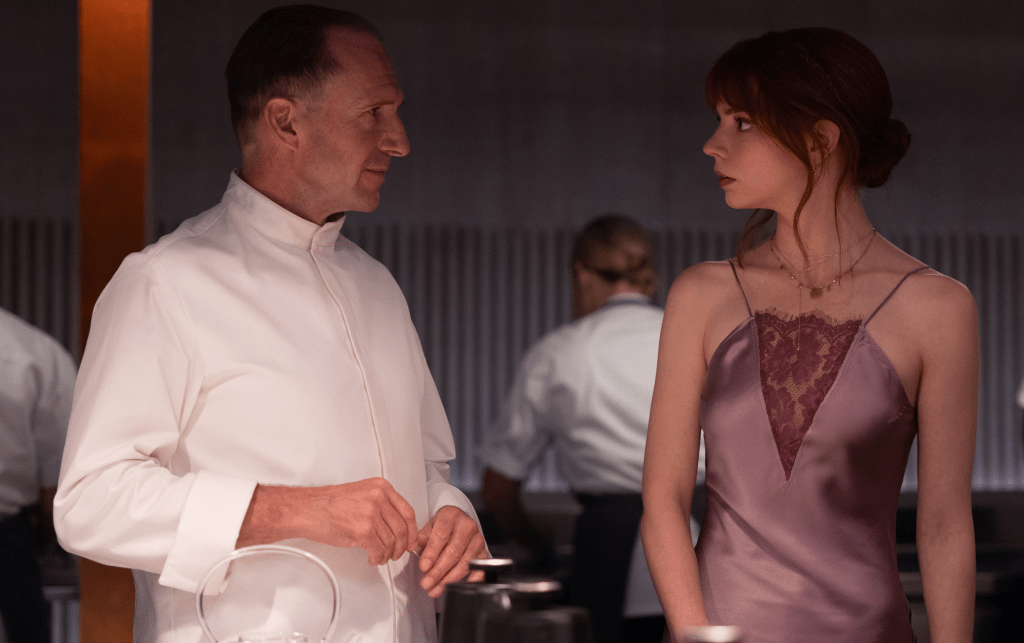
The Menu also breaks the fourth wall to demonstrate that Margot has come up with an idea: she tells Mr. Slowik that she is still hungry and that she desires a cheeseburger. An ethereal non-diegetic sound plays throughout the scene as the camera focuses on Chef Slowik’s smiling face as he makes the cheeseburger: he is reminded of why he started cooking in the first place. Simultaneously, he is reminded of how capitalism and the need to “satisfy people who can never be satisfied” (Mylod) has ruined his art.

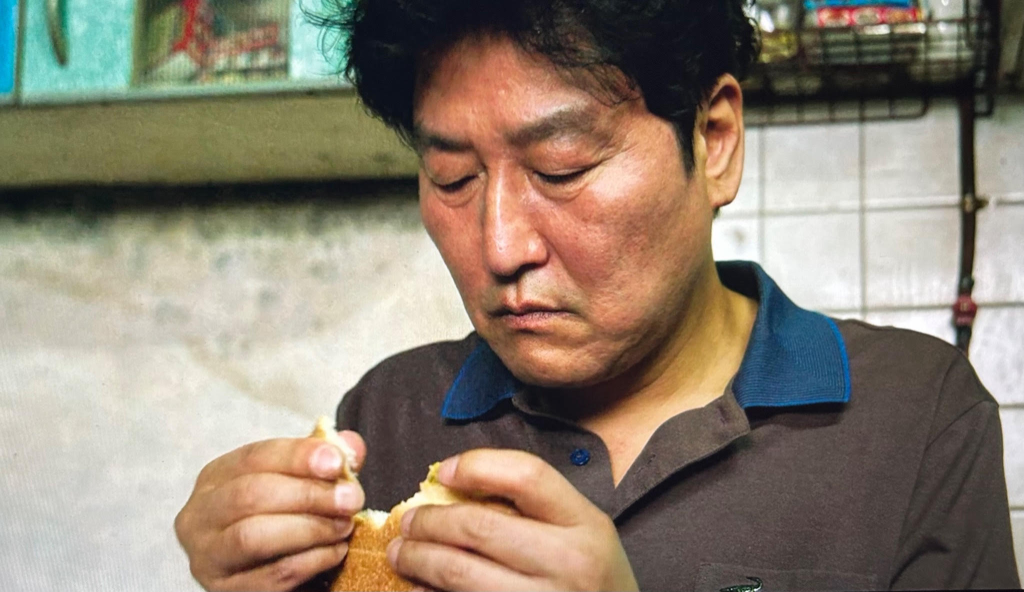
The motif of food in general, though more relevant to The Menu, helps convey the themes of both films. In The Menu, Chef Slowik creates extremely intricate, pretentious dishes, which Margot calls “intellectual exercises,” (Mylod) to please the ungrateful, wealthy customers. When he asks Mr. Leibrandt, a man on the island who is a recurring guest at the restaurant, to “kindly name one dish [he] ate the last time [he was] here” (Mylod), he is unable to, indicating that the upper class is not grateful for what they have. Making the cheeseburger for Margot is such an awakening for him because he goes back to his roots for the first time and makes a dish that someone truly savours. Beyond the cheeseburger, Mr Slowik’s menu is carefully planned out and conveys meaning. At one point, he refuses to serve bread since he says it is the food of the common man, emphasizing the superiority of the people on the island. Food plays a role in Parasite as well. In the beginning of the movie, Mr Kim is seen eating bread, but when the Kim family begins to make more money, there are several clips of them sitting at a table, or filling their plates up with food. Eating becomes less of a mundane necessity and more of an enjoyable experience for them.
Going back to The Menu, Chef Slowik kills the guests by dressing them up like s’mores and lighting the building on fire, which he prefaces by calling them “the most offensive assault on the human palate ever contrived. It’s everything wrong with us and yet we associate it with innocence, with childhood, with mom and dad” (Mylod). By killing them in this way, he demonstrates that like the s’mores, he views the guests as everything wrong with the world.
Like in The Menu, Parasite is full of important motifs and symbols that help demonstrate the film’s meaning. For instance, the stone that Ki-Woo receives from his friend at the start of the film is supposed to represent the Kim’s desire for wealth. It is saved by Ki-Woo in the flood and, in the shelter, he falls asleep grasping onto it, desperately holding on to that goal. However, it is that very stone that is used to almost kill Ki-Woo. The film aims to criticize this drive for prosperity which is rooted in capitalism, and illustrates that wealth and capitalism are parasitic – people will latch onto them and stop at nothing to achieve them. In the Kim family’s case, that meant conning a family, stealing jobs, and killing Moon-Kwang, the housekeeper whose husband was living in the basement of the Park’s family home (“Parasite – The Power of Symbols”).

While the stone represents the Kim’s desire for wealth, smell represents their inextricable link to poverty. The first time it is brought up, it is the young boy, Da-Song, who points out that all the members of the Kim family share the same smell. Even someone as young as Da-Song is aware of their economic differences (Noh). Mr. Park brings it up several times, thereafter, mocking them and saying, “you know when you boil a rag?.. But that smell crosses the line… You sometimes smell it on the subway”(Joon-Ho). He recounts these insulting revelations about the Kim family to his wife, not knowing that the Kim’s are within earshot. Mr. and Mrs. Park are at an elevated point, visually demonstrating their superiority. This foreshadows the ending of the film when Mr. Park, in a slow-motion close-up shot, blocks his nose due to the smell of the man living in his basement. Mr. Kim then snaps and stabs Mr. Park and runs away to hide in the basement. Therefore, contrary to the hope that is tied to the stone, their smell is meant to symbolize the impossibility of attaining wealth and the family’s doomed fate (“Parasite – The Power of Symbols”).
To conclude, both the award-winning South Korean thriller and the satirical American film demonstrate in unique ways how the dissatisfaction and hatred that arise from capitalism will inevitably lead to fatalities and devastation.
Works Cited
Barsam, Richard Meran, and Dave Monahan. “Looking at Movies : An Introduction to Film.” 7th ed. W.W. Norton & Company, 1, Oct. 2021.
Montanari, Melissa, and Marika Avenel Brown. “Analysis: Horror comedy ‘The Menu’ delves into foodie snobbery when you’re dying for a cheeseburger.” McMaster UNIVERSITY, 23 Jan. 2023, https://brighterworld.mcmaster.ca/articles/analysis-horror-comedy-the-menu-delves-into-foodie-snobbery-when-youre-dying-for-a-cheeseburger/.
Noh, Minjung. “PARASITE AS PARABLE: Bong Joon-Ho’s Cinematic Capitalism.” CrossCurrents, vol. 70, no. 3, 2020, pp. 248–62. JSTOR, https://www.jstor.org/stable/26975087.
Parasite. Directed by Bong Joon-Ho. Barunson E&A, 2019.
“Parasite: Cinematography, Mise-en-scène and Verticality.” TFTI, 11 Dec. 2020, https://www.youtube.com/watch?v=TyXMkYMqzcI.
“Parasite – The Power of Symbols.” Lessons from the Screenplay, 26, Mar. 2020, https://www.youtube.com/watch?v=he3x5flTFPg.
Shachat, Sarah. “Mark Mylod Designed ‘The Menu’ to Its Exacting Chef’s Specifications.”
IndieWire, IndieWire, 28 Nov. 2022, www.indiewire.com/features/general/the-menu-mark-mylod-toolkit-interview-1234784856/. The Menu. Directed by Mark Mylod. Searchlight Pictures, 2022.
 SUBTEXT JOURNAL