
Written by Élise Léger for Justine McLellan’s Cinema Styles course
Aftersun (2022) is a film acting as intimate memories reminisced by daughter Sophie (Frankie Corio) about a vacation spent with her father (Paul Mescal) in the 1990s. Directed by Charlotte Wells, the film deals with themes of depression, connection, and detachment. These themes are well illustrated by Wells who tackles this in an unique way, ultimately serving the story justice. The quiet, simple dialogue enables the viewer to interpret things outside the constraints of obvious scripting. The themes are manifested through the use of realistic dialogue and sound design that embraces silence, and the movie is beautifully edited to create the feeling of a distant memory.

The viewer often utilizes the opening sequence as an anchor to remind themselves of what the movie is about. Aftersun executes this in an alluring way as there is no narration to indicate what is about to unfold. The sound of a VHS tape whining and rewinding captures the moments from a camcorder at the start of the film which reveal to the audience what they will later understand to be Sophie’s memories. The tape rewinding effect juxtaposed with the indirect depiction of the characters – often using reflections, offers a more intimate view into their state of self and demonstrates what is unsaid best. Leigh Singer in a review for BFI Sight and Sound wrote, ” semi-obscured framing expresses both the young Sophie’s oblivious perspective and her older self’s heightened attempt to reconstruct a picture of her father that will not ever fully shift into focus” (Singer). Moreover, some scenes almost frame the character outside of the shot. For instance, at minute 41 of the film, Calum is looking at himself in the bathroom’s mirror, left of the frame. Rather than focusing squarely on Calum, the camera comes from behind him as it fits the back of his neck and the reflection of the mirror (Wells, 00:41:40 — 52). Without this approach, the vulnerable moment as Calum tries to ground himself by spitting in the mirror would have been lost. In contrast with the different stylistic approaches, Wells curates this moment to feel intimate, as the audience witnesses a private moment between Calum and himself, not intended for his daughter to see. This further highlights the signs of depression and loneliness Sophie missed; although obvious to the audience, it is obscured due to her innocence.
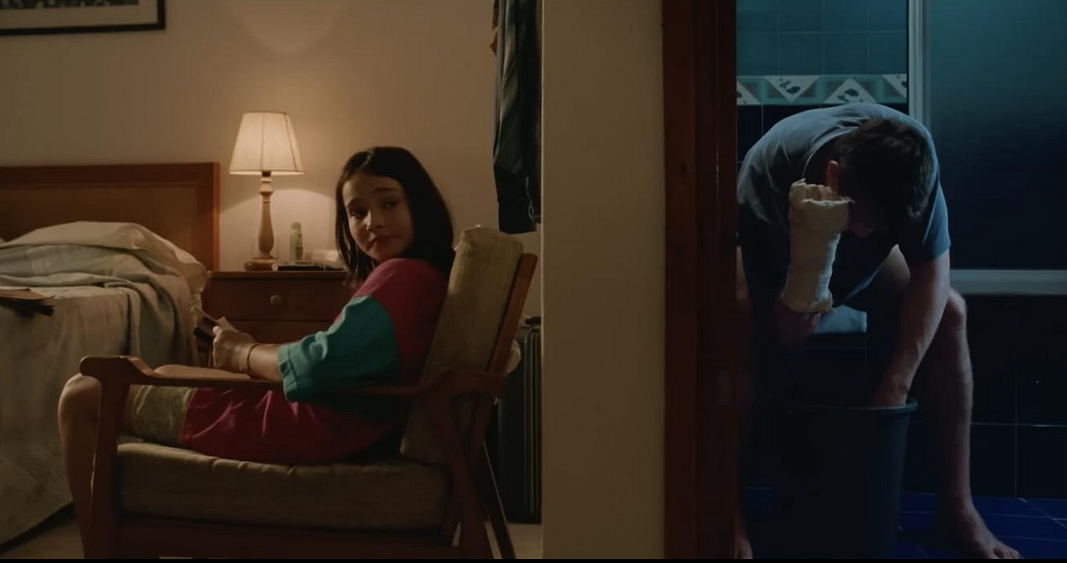
In regards to sound, silences are what speak loudest. The film uses diegetic sound, pulling the audience into private moments. The film remains emotional, but the absence of non-diegetic sound is better suited, as opposed to unnecessary music having been added. This allows the viewer to appreciate the scenes for what they are, rather than having scenes decorated with music to fill the silence. This sentiment is shared by Nurak Gilman from Offscreen who writes, “It is a sadness that is not revealed during their time together but can be sensed and traced” (Gilman). A moment most reflective of this is when the mention of Calum turning “131 years old” is revisited (Wells, 00:50:40 – 52:46). Calum is asked what his aspirations were when he was Sophie’s age; 11 years old. Unwilling to answer, Calum shifts the tone, abandoning his daughter’s lighthearted curiosity, and shows discomfort towards the question, requesting the camcorder to be turned off. Quickly noticing the shift in his own demeanor, Calum seems to feel remorseful for getting upset at Sophie, and tries to return to the atmosphere set before. By leaving space for silence, the audience is able to read into the scene and listen to what Calum leaves undisclosed. The viewer can thus later understand that those moments triggered the resurfacing of unwanted memories from his childhood. The use of diegetic sound captures the themes of depression, connection, and detachment as those are better emphasized in their raw form.

Finally, the simplistic dialogue is an important element of the film, allowing the viewer to access the characters’ unpolished memories. Wells’ use of realistic dialogue elicits the search for connection felt throughout the film. Indeed, after Sophie turns off the camera, Calum states that for his 11th birthday, his family had not remembered his birthday, and he briefly describes an unhappy memory (Wells, 00:53:35 – 54:06). Simple dialogue was used for Calum and Sophie to extend a metaphorical hand to each other, establishing a connection. Calum reveals to his daughter a melancholic and possibly shameful part of his youth. This was later kindly addressed by Sophie who requests their tour group serenade him for his birthday (Wells, 01:25:27 – 26:20). Through simple dialogue, a connection based in understanding is established between the father and the daughter. “It’s hard to find a critical language for the delicacy and intimacy of this film,” writes A.O Scott for The New York Times (Scott).
Aftersun makes its viewers feel as though they are peering into personal memories. Themes of melancholy, nostalgia, and connectedness are captured a lot in films, but Wells’ artistic vision is able to deliver a pure and raw depiction of how it feels to try to grasp complex concepts as a teenager. Aftersun succeeded in exploring each theme carefully, representing them through the subtleties of life. Had an element been altered, such as non-diegetic and diegetic, then the dreamlike frailness of the film would have collapsed. The harmonious uses of cinematographic editing, sound mixing, and realistic dialogue help support the themes of depression, connection, and detachment, allowing the viewer to receive the intricate message of the film. Memories are hard to reimagine, sometimes even to revisit, but Wells achieved in doing so transparently.
Works Cited
Bogutskaya, Anna. “Aftersun.” TimeOut. May 22 2022. Review: Paul Mescal powers the emotionally devastating ‘Aftersun’
Scott, A.O. “‘Aftersun’ Review: A Father and Time.” The New York Times. October 20, 2022 ‘Aftersun’ Review: A Father and Time – The New York Times .
Singer, Leigh. “Aftersun peers through rosy girlhood memories to a father’s hidden gloom.” BFI. May 24 2022 https://www.bfi.org.uk/sight-and-sound/reviews/aftersun-peers-through-rosy-girlhood-memories-fathers-hidden-gloom
Wells, Charlotte, director. Aftersun. A24, Mubi, 2022.
Yilmaz, Burak. “Aftersun (2022): The Blues of Ordinariness.” Offscreen. Offscreen, December 1 2022. Aftersun (2022): The Blues of Ordinariness – Offscreen.
 SUBTEXT JOURNAL