
Written by Luca Graziani for Justine McLellan’s Cinema Styles course
Following the lives of mixed-race couple Kyra and Jake, who purchase an android named Yang to teach their adoptive child Mika about her Chinese culture and heritage, After Yang explores the theme of Asian identity through the means of technology, nature, and the instrumental contrast hidden within the score. Along with the absence of Chinese languages, director Kogonoda illustrates the feeling of duality many Asian-Americans are faced with.
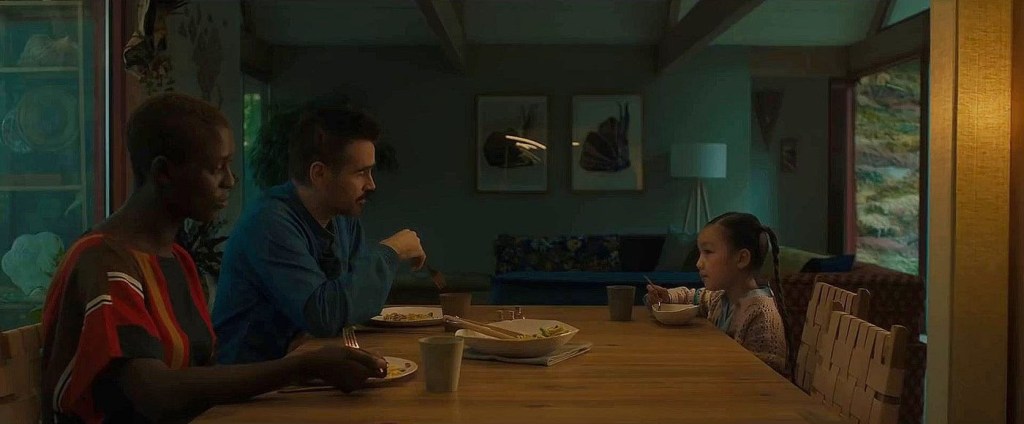
After Yang is a 2021 science-fiction drama by the Korean-American director, Kogonada. The film challenges the audience’s expectations of a science-fiction film, using organic spaces as a tool to subvert the viewers presumptions about Asian science-fiction. The science-fiction genre is heavily saturated with films encapsulating the cyberpunk aesthetic, displaying a cold, dark futuristic society, and, more often than not, set in cities that resemble Asian metropolises, such as Tokyo or Seoul. Director Kogonoda envisioned a world opposite of this normality, filling it with natural life. The characters are surrounded with plants, woods, fabrics, and hardly any plastics or processed materials. Emily Zemler, a journalist, wrote via the Observer that “the world Kogonada builds feels completely untrue and wholly immersive. This is a time and place that could exist. Instead of sterile, futuristic spaces, the director surrounds the characters with organic life, emphasizing the uncertain growth of plants around the interiors” (Zemler). It is in these “sterile and futuristic spaces” that Western cinema often showcases Asian characters, portrayed as robotic and expressionless. This is a trope within the science-fiction genre that Kogonada utilizes to his advantage, depicting a character like Yang in a setting opposite to what the audience is used to. This already places Yang, an android created in the image of a Chinese man, within a more human environment.
Previously, the use of an organic setting was discussed in order to exemplify the tropes that are often displayed using Asian characters. Media and real life constantly influence one another with the reason for Asians being perceived as robotic and expressionless being Western perspectives. One of the many explanations for the birth of this stereotype is eastern Asia’s incredible economic and technological growth following WWII. This stereotype stemmed from the American’s fear of losing their spot as the “number one country” and caused a lot of harmful stereotypes about Asians with the goal to alienate, to think of them as less than human. Where After Yang fits in all of this is with its score. Japanese composers Aska Matsumiya and Sakamoto Ryuichi came together with a clash of wooden instruments and synths, the latter notably processed through machine learning. This contrast of newer and older techniques can be seen as an allegory for the duality that many Asian-Americans are confronted with throughout their life. The music mirrors the technological growth of these Asian countries, while at the same time, keeping traditions with the wooden instruments. In an interview with Composer Magazine, Matsumiya stated, “We wanted to make sure that the sound was both new and futuristic, but also very human at the same time […] It’s a paradox because, even though it’s set in the future, it is important to return to the essence of humanity – to stay in touch with our human side” (Yalcinkaya). The score demonstrates the shared identity of native and immigrant Asians; they are human like everyone else and deserve compassion. They are not machines or robots; they are human.
A striking component of After Yang is the ways in which the characters interact with each other, including Yang. The dialogue is slow-paced and every word serves a purpose, impacting the viewer profoundly. Certain pieces of dialogue are repeated, as if being stored in Yang’s memory, reminding the viewer Yang is an android. The film humanizes Yang so much that, at times, it feels as though he is not actually AI. On a few occasions, Yang says phrases unlikely to be heard from a robot, such as: “It would seem as though I lost my train of thought” (Kogonoda, 00:51:53 – 55). Would it really be possible for Yang to “forget” what he is about to say? One could argue this may be Yang’s way of comforting the humans around him, altering his own speech to mimic that of a human’s and making them feel like they are interacting with another human. Subtly, this can be seen as a metaphor, depicting the reality of Asian immigrants coming to the West. Immigrants may change the way they speak or act in order to fit into Westerners’ societal standards, causing them to lose parts of their identity over time.

In conclusion, After Yang is a film that devotes a lot of its resources to showcasing the struggle that many Asian-Americans encounter during their life. Through its design and music, this film meticulously crafts a world far from the norm within the science-fiction genre. After Yang uses subversion of said traits in order to bring Asian identity to the forefront, demonstrating that regardless of societal norms and technological advancements, we are each with our own identities and values.
Works Cited
Kogonoda, director. After Yang. Score by Aska Matsumiya and Sakamoto Ryuichi. A24, 2021.
Zemler, Emily. “‘After Yang’: Fixing an Android Leads to a Precise, Beautiful Examination of What It Means to Be Human.” Observer, 5 Mar. 2024, observer.com/2022/03/after-yang-fixing-an-android-leads-to-a-precise-beautiful-examination-of-what-it-means-to-be-human/.
Aska Matsumiya’s Score for After Yang Dissipates the Boundaries Between Man and Machine.
Yalcinkaya, Gunseli. “Aska Matsumiya’s Score for After Yang Dissipates the Boundaries Between Man and Machine.” Composer Magazine, composer.spitfireaudio.com/en/articles/aska-matsumiyas-score-for-after-yang-dissipates-the-boundaries-between-man-and-machine.
 SUBTEXT JOURNAL