
Written by Berdie Pidika Matondo for Justine McLellan’s Cinema and Culture course
Ru is a 2023 Québécois film directed by Charles-Olivier Michaud based on Kim Thúy’s 2009 novel of the same name. Both works recount the story of a Vietnamese family that migrates to Quebec in 1978, three years after the Vietnam war. The adaptation to a new environment is seen through the protagonist Tinh’s eyes, Kim Thúy’s alter ego.
The film alternates between Tinh’s memories of Vietnam and the reality she faces in her new society. Vietnam was going through difficult times; the ongoing war led the family to flee the country. In 1955, Ngo Dinh Diem created the “Republic of Vietnam.” Shortly after, the country was separated in two, the United States’ controlling the southern part of the country and the Chinese/USSR’s ruling over the north. In the years that followed, disagreements arose between both sides. For instance, Diem “believed that worsening conditions in the north would prompt huge numbers to flee, causing the ‘other Vietnam’ to collapse, enabling the RVN [Republic of Vietnam] to expand over the entire territory of the country” (Bill). Said sentiment was also felt in the north because they wished to see the south collapse. In 1968, during Tet, the new year, an offensive took place: “On January 30, 1968, just as the country settled down for the Tet (lunar new year) holiday, 80,000 fighters attacked military bases, population centers and key city buildings all across the RVN, expecting to trigger a popular revolution” (Bill). Tinh was born during the Tet offensive. In 1975, the war finally ended and the country was reunified in 1976 by the north gaining control. Overall, between 1975 and 1980, “perhaps 800,000 ‘boat people’ left Vietnam” (Bill). Refugees who fled Vietnam post-war due to “the political and economic conditions that prevailed after 1975” were called “boat people” as they left the country by sea(Bun 289). In Canada, and more specifically Quebec, the 1970s marked the consequences of the Quiet Revolution; the province saw its modernization, attendance in church was decreasing, and more children were educated. Canadians warmly welcome Vietnamese refugees, the country raising its quota of migrants during that period (Hou 4818). Vietnamese mostly settled in Alberta, British Columbia, Ontario, and Quebec (Dorais 2).
Ru accurately depicts the socio-cultural context of the time. The film begins with a sequence that portrays the mundane life of a wealthy family in Vietnam before the war; Tinh’s family is trying to take a family picture. Shortly after, they are disrupted by the sound of soldiers approaching. Nguyen, the mother, and Minh, the father, must decide whether or not they should leave the country, as it has become increasingly dangerous. Multiple scenes depict soldiers using physical force to terrorize Tinh’s family, reflecting real-life experiences of the time. As Bill Hayton states in his book A Brief History of Vietnam : Colonialism, War and Renewal: The Story of a Nation Transformed, “At the same time, however, the northerners moved to enforce political control. More than a million former officials, soldiers and intellectuals were summoned for what was officially called hoc tap cai tao—re-education” (Hayton). For example, the family is forced to destroy their library and burn their books. This was done as an attempt to control the knowledge that would be passed down to the population. When Tinh’s family arrives in Quebec in 1978, they are welcomed by open-minded Quebeckers, an attitude which could be attributed to the modernization of the province following the Quiet Revolution. The secularization of the province is also felt throughout the film. Apart from a scene where Tinh is cleaning a church, nobody attends any Sunday services. The Quebec society is secularized and several characters even cuss when referring to religion. Lastly, all children, even Tinh’s two younger brothers, attend school. Roger Magnuson, in his article Education and Society in Quebec in the 1970’s, explains, “By 1967-68, the percentage of children enrolled in kindergarten had jumped to 62.9” (Magnuson 95).

Three of the film’s main themes tie into the broader social and cultural issues relevant to 1970s Quebec: the adaptation to a new cultural environment, the overqualification of immigrants in the workforce, and a coming-of-age for the eldest child. Firstly, Ru depicts the difficulties associated with needing to adapt to another country’s culture and social norms. When Tinh’s family meets their parrains — locals responsible for accompanying immigrants into their new lives, Nguyen explains to Lisette, the mother, that, although she and her daughter share the same name, their names are punctuated differently and thus, hold different meanings. However, Nguyen quickly understands that this will not have its importance in Quebec; she will have to leave that part of her identity back home. Furthermore, Tinh’s youngest brother also has trouble adapting to his new environment, asking his older sister when she thinks they will be going back to Vietnam. Nevertheless, the person for who it takes the longest to understand culture is Tinh since “ce n’est qu’à la fin [qu’elle] apprivoise le territoire québécois, s’essayant à la raquette ou visitant une cabane à sucre avec sa famille” (Du Ruisseau). Eventually, the family gets used to eating Québécois food, learns French, and bears the long and cold winters.
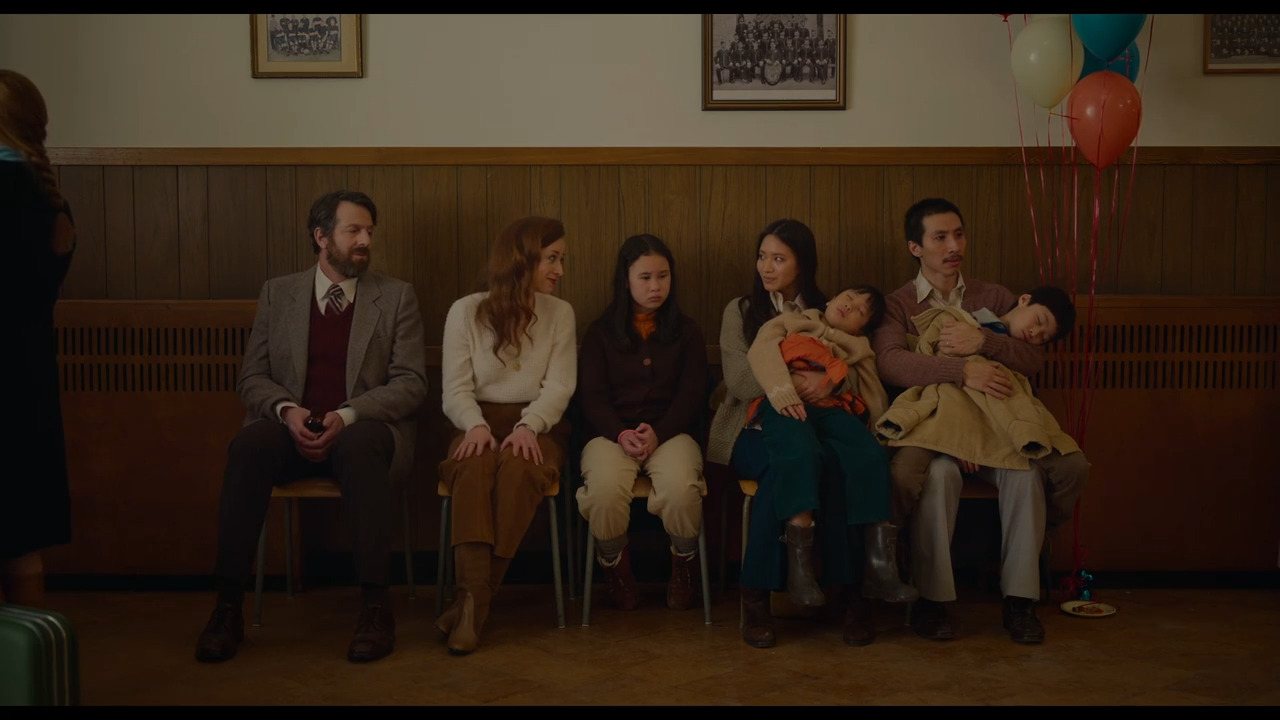
Secondly, the movie showcases the challenges of working a job for which one is overqualified. Manon Dumais explains, “la mère et le père de Tinh, Nguyen (Chantal Thúy) et Minh (Jean Bui), sont contraints d’occuper des emplois pour lesquels ils sont surqualifiés” (Dumais). Although Minh has a degree in law, worked for the Vietnamese government, and studied French in university, upon his arrival, he has no choice but to work in a restaurant if he wishes to feed his family. Likewise, Nguyen works in the textile industry. Nguyen and Tinh are amongst the “well-educated professionals, middle-class [refugees]” of the first set of refugees from Vietnam (Hou 4820).

Thirdly, Tinh’s coming-of-age process is another important aspect of Ru. Tinh barely talks throughout the movie since “Charles-Olivier tenait à évoquer, sans recours à du dialogue explicatif, le sentiment d’enfermement qui accable Tinh, et duquel elle se départira à la fin” (Lévesque). At the beginning of the film, Tinh is often thinking about Vietnam and the life she left. It is almost as if she is imprisoned by everything she experienced, things no 10-year-old child should have to go through. However, at the end of the film, Tinh starts to understand what the future has to offer. For instance, she is finally able to write a full sentence in her diary, something an older man who works with her father had suggested she should do.
Ru ends with a version of Tinh that is different from the one portrayed in the beginning. While she is reserved and quiet in the first minutes of the film, she evolves into a more open, lively and opinionated character. Charles-Olivier Michaud’s Ru portrays the moving and personal story of Tinh; Kim Thúy. Through Tinh’s lens, the audience is moved by the traumatic experience of boat people, but also captivated by a Vietnamese family’s adaptation to 1970s Québec. Ultimately, Tinh’s transformation shows the beauty that can emerge from difficult experiences.
Works cited
Dorais, Louis-Jacques and Eric Richard. “Statistical profile of Immigrants of Vietnamese Origin in Quebec and In Canada: Comparison of 1991, 1996, and 2001 Data.” Review of Vietnamese Studies, vol. 3, no. 1, 2003, www.researchgate.net/publication/265672927_STATISTICAL_PROFILE_OF_IMMIGRANTS_OF_VIETNAMESE_ORIGIN_IN_QUEBEC_AND_IN_CANADA_COMPARISON_OF_1991_1996_AND_2001_DATA_1
Dumais, Manon. “Ru: Vers une vie meilleure.” La Presse [Montréal], 24 Nov. 2023, www.lapresse.ca/cinema/critiques/2023-11-24/ru/vers-une-vie-meilleure.php
Du Ruisseau, Olivier. “«Ru»: la force du silence.” Le Devoir [Montréal], 24 Nov. 2023, www.ledevoir.com/culture/cinema/802565/cinema-force-silence
Hayton, Bill. “A Brief History of Vietnam : Colonialism, War and Renewal: The Story of a Nation Transformed.” Tuttle Publishing, 2022.
Hou, Feng. “The resettlement of Vietnamese refugees across Canada over three decades.” Journal of Ethnic & Migration Studies, vol. 47, no. 21, 2020, pp. 4817–34. Taylor & Francis, doi.org/10.1080/1369183X.2020.1724412.
Kwok Bun, Chan, and Louis-Jacques Dorais. “Family, Identity, and the Vietnamese Diaspora: The Quebec Experience.” Sojourn: Journal of Social Issues in Southeast Asia, vol. 13, no. 2, 1998, p. 285‑308. JSTOR, www.jstor.org/stable/41056991.
Lévesque, François. “Ramener Kim Thúy au cœur de «Ru».” Le Devoir [Montréal], 17 Nov. 2023, www.ledevoir.com/culture/cinema/802103/cinema-quebecois-ramener-kim-thuy-coeur-
Magnuson, Roger. “Education and Society in Quebec in the 1970’s.” The Journal of Educational Thought (JET) / Revue de la Pensée Éducative, vol. 7, no. 2, 1973, p. 94‑104. JSTOR, www.jstor.org/stable/23767978.
Michaud, Charles-Olivier, director. Ru. Amalga, 2023.
 SUBTEXT JOURNAL