Written by Aïyana Faye-Giard for Kim Simard’s … class
At the end of the 20th century, just as the world was slowly recovering from two World Wars, a violent tragedy shook the province of Quebec. On December 6, 1989, fourteen women were brutally murdered on the Polytechnique campus, in response to a young man’s anti-feminist revolt (Lanthier, ‘‘Polytechnique’’). While the pain of this event lingers in the hearts of Quebec society, the commemoration of its victims is a particularly delicate quest to undertake. This essay will analyze Denis Villeneuve’s film Polytechnique, produced to mark the 20th anniversary of the femicide. It will explore how this work is an honorable attempt to do justice to and to remember these women through the use of cinematography in terms of character development and symbolism for the Killer, Jean-François, and Valérie.
“A day before the massacre everyone would have pitied him, but then he commits this massacre, and the next day, he is a monster to everyone,” declares a friend of the murderer in the CBC News documentary, Montreal Massacre – Legacy of Pain – the fifth estate. Just like this documentary delves into the young man’s life through his complicated family history and interviewing close friends, Villeneuve’s artistic choices greatly contribute to the humanization of the criminal and most importantly, his sanity, subverting audience expectation. The letter the character writes to his mother, which is close to factual events, states his intentions of murdering women in – successful positions or public figures, such as the presenter of the documentary Francine Pelletier, setting the tone in grasping the Killer’s mindset. This particular frame of mind is discussed in Rachel Kalish & Michael Kammel’s article Suicide by Mass Murder: Masculinity, Aggrieved Entitlement, And Rampage School Shootings, where the authors use the term ‘aggrieved entitlement’ to describe the mental state of these violent men.These men feel powerless due to previous emotional wounds or current situation and, through exuberant toxic masculinity, consider that they have the right to resort to violence to get what the world owes them – be it recognition, respect or privilege. Suicide at the end of their crime is also a common trait, as they feel no sense of guilt for their actions and yet, wish to not bear their consequences. Added to this are cinematic cues, such as melancholy string and piano music every time the antagonist enters the frame, creating tension and anticipation for the viewer who knows that the criminal may act at any moment, although he generally remains calm, heightening the shock of the gunshot at the crucial moment. Various shots, in his kitchen, his car, or even outside, also present a landscape where he contemplates the snow, seemingly cold and alone. These layers of artistic choices all serve to depict this man’s isolated suffering, but also to remind us that he was in fact sane when he committed the femicide, which serves the purpose of providing nuanced remembrance and raising awareness to the normalcy from which violence emerges in our societies.
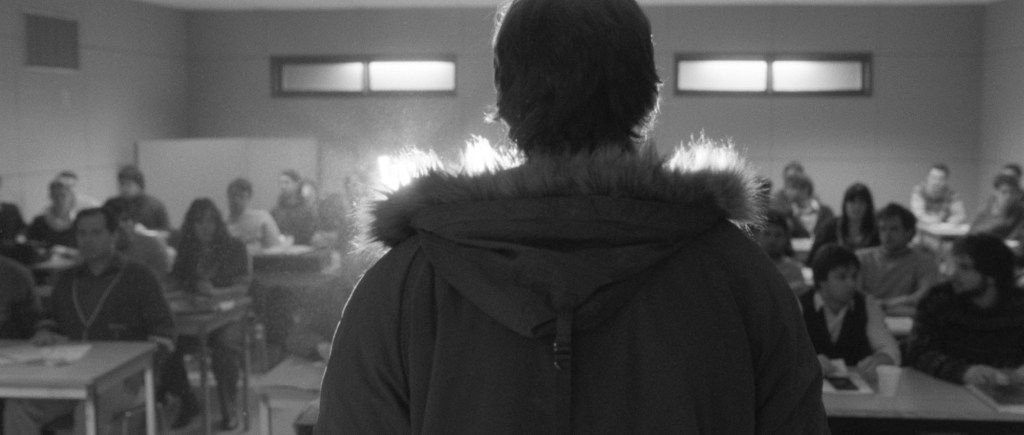
Jean-François is a particularly clever addition on Villeneuve’s behalf. For while all the characters are fictitious, as mentioned at the start of the film, Jean-François’ character stands out for the fact that the point of view of a witness is not generally represented as often as the dichotomous roles of perpetrator and victim. It reflects the viewer’s feelings about the repercussions of the tragedy and powerlessness over the situation, just like the citizens of yesterday and today. As Brenda Longfellow points out in her essay The Practice of Memory and The Politics of Memorialization: Denis Villeneuve’s Polytechnique, the close-up shot of a character’s face staring intently at something, followed by the next shot of Picasso’s Guernica hanging on the wall, is one of the film’s most symbolic sequences. The painting was made after the first aerial bombardments of the Spanish Civil War and represents the shock and desolation of the population that followed. Its story then draws a parallel with the tragedy of Polytechnique, the first school shooting in Canada, while illustrating the feelings of Jean-François and all the victims in the face of the massacre: absolute devastation. The symbolism of snow persists from the Killer’s character to Jean-François’ as a marker of their ultimate sense of isolation, particularly with the aerial shot of the white landscape contrasting with the dark car filled with oil fumes in which he commits suicide. But before this act of despair, Villeneuve has carefully prepared his audience for the fall by depicting a bumbling, cheerful character who, after the massacre, suddenly loses his spark. This is shown in a literal sense through a medium shot, which depicts the despairing witness in the dark, barely discernible, flickering the flame of a lighter. The resemblance between Jean-François and the Killer is also a complex choice and contributes to the prevention of mental health, albeit in a way that does not properly serve the cause of women, as both men commit suicide and the surviving woman thrives, full of resilience. Unfortunately, an issue with this character is that his role has taken precedence over that of the women, both in terms of screen time and action, sometimes presenting him as the “brave hero saving damsels in distress”, which undoubtedly puts the wrong person on a pedestal, despite Longfellow underlining the intent, done in regards to, “…the students allegedly felt that the Massacre had been overly politicized by feminist interpretation’”(100). Nevertheless, Jean-François’ presence brings the event and the viewer very close together, contributing to its powerful memorialization.

Polytechnique (Denis Villeneuve, 2009)
Last but not least is the character of Valérie. This unconventional woman, whether it is as a product of her career choice, her shoes, or her haircut, carries on her shoulders the weight of representing the unique story of a survivor of the massacre and embodying the lives and dreams of the murdered women. Villeneuve does an incredible job of symbolizing this through the bathroom scene where Valérie is filmed first in close-up looking at her reflection after her harrowing interview, then from a wider angle, facing endless reflections of herself through mirrors, as if facing all her classmates who have remained behind her. Occasional misogynistic remarks are another important element of the scenario, as during the interview, when the examiner encourages her to opt for civil engineering because it will be easier once she has children, and, immediately afterward, when she leaves her elegant high heels, required to be ‘presentable’, for comfortable shoes. Longfellow explores this clever two-faced parallel with the feminist cause:
This acknowledgment of everyday sexism allows the film to profess a form of moderate (and acceptable) feminism (limited to a discussion of career options and advancement in nontraditional careers) while distancing itself from the more radical versions of feminism that insisted on the brute reality of gender difference and systemic misogyny as the root causes of the Massacre’(101).
Valérie as a representative of solidarity with the victims is also crucial and can be seen in the classroom shooting scene where close-ups of clasping hands and defying eyes, follow one another to ratchet up the dramatic tension. Her character is courageous and resilient and offers an honorable memorial to the victims, but perhaps too much so. In comparison with Jean-François, the scars of the event are not obvious enough. Despite the moving close-up of her weeping face by the telephone, Villeneuve offers no depiction of a dysfunctional relationship or career as a sign of PTSD, and everything leans too much towards a Disney-like happy ending, especially with the arrival of a baby, a symbol of rebirth, of letting go of the past and moving forward into the future. The ending depicts Valérie in a medium shot, peacefully seated under a tree, writing to the Killer’s mother. This seems to exaggerate reconciliation and may overly contrast with reality, where the survivor would just be recovering from the traumatic event and would probably be far from ready to contact anyone connected with the perpetrator. Nevertheless, this character, with her distinct personality and powerful shots, honors the victims in their singularity and in the common tragedy they share.

Polytechnique (Denis Villeneuve, 2009)
In conclusion, in his film Polytechnique, Denis Villeneuve succeeds in portraying complex characters through brilliant cinematographic choices that allow the audience to remember distinct perspectives of the event. Much like this essay, the majority of the film still revolves around the male experience of the massacre rather than that of the women. This does not make Polytechnique a bad memorial, but rather lends value to the other “lieux de mémoire”(88). Ultimately, a plurality of narratives and representations of the event is the best way to memorialize such a tragedy.
Works cITED
CBC News. “Montreal Massacre – Legacy of Pain – the Fifth Estate.” YouTube, 27 Nov. 2014, www.youtube.com/watch?v=spsAJ76rP3I.
Lanthier, Stéphanie. “École Polytechnique Tragedy (Montreal Massacre).” The Canadian Encyclopedia, 5 Jan 2012, www.thecanadianencyclopedia.ca/en/article/polytechnique-tragedy.
Longfellow, Brenda. ‘‘The Practice of Memory and The Politics of Memorialization : Denis Villeneuve’s Polytechnique.’’Canadian Journal of Film Studies. vol. 22, no. 1, Spring 2013, pp.86-106. JSTOR, www.jstor.org/stable/24411755.
Kalish, Rachel and Michael Kimmel. ‘‘Suicide by mass murder: Masculinity, aggrieved entitlement, and rampage school shootings.’’Health Sociology Review. vol.19, no.4, Jan. 2010, pp.451-464. Taylor & Francis, doi.org/10.5172/hesr.2010.19.4.451. Villeneuve, Denis, director. Polytechnique. Remstar. 2009.
 SUBTEXT JOURNAL