Written by Michaela Charbonneau for Dr. Magdalena Olszanowski Cinema & Communications: Selected Topics course
*This text contains spoilers to the film Midsommar
The night-winds come and go, mother, upon the meadow-grass.
And the happy stars above them seem to brighten as they pass;
There will not be a drop of rain the whole of the livelong day,
And I’m to be Queen o’ the May, mother, I’m to be Queen o’ the May.
— The May Queen, Alfred Tennyson
Wearing a white gown with a wildflower crown, the young blonde dancer, prances round and round the maypole. Bodies dance, dizzy, and drop. They drop until only one remains standing, holding a single flower crown, frowning. Dani (Florence Pugh) has won the title of the May Queen and now must decide who she will sacrifice during the last ritual of the Midsommar festival.
Ari Aster’s 2019 film Midsommar takes place at the beginning of summer within the sun-kissed fields of Sweden where the Hårga cult is starting to welcome outsiders for their fabled Midsommar festival, a four week-long festival that celebrates rebirth, fertility and the coming of light.

Midsommar, (Aster, 2019)
American anthropology students, Christian (Jack Reynor), Mark (Will Poulter) and Josh (William Jackson Harper) are invited by their Swedish friend Pelle (Vilhelm Blomgren) to participate in the festivities. Simultaneously, Dani, Christian’s girlfriend, is grieving the loss of her parents and sister and finds herself leaning on Christian for emotional support. Christian, who has been neglecting their relationship, even considering breaking up with Dani, is now trapped in the role of Dani’s main support system. Consequently, Christian feels forced to invite Dani on this trip, a trip which will finally allow her to punish him for his dominating control over her. In Sweden, Dani finds a family with the Hårga community, claims her power through the language of flowers, and unveils her destiny through their art. Dani’s journey depicts the consequences of living in an androcentric society that deprives women of their true destinies and the inevitable path to self-discovery of transitioning into a female-centered society.
The language of flowers in Midsommar holds significant importance in Nordic Utopia through the lens of Dani’s experience of Sweden. Dani is the only outsider who is able to connect with nature. This could be attributed to her desire to acclimate to Nordic culture or to the fact that she is the only woman in the group of Americans willing to open herself up to Hårga without judgment. Mark, Josh, and Christian all had different intentions when it came to accepting this opportunity: Josh to write his dissertation, Christian, to steal Josh’s ideas, and Mark, to follow along without any conscious intent to adapt to their new environment. On the contrary, Dani travels while at her lowest, allowing the Hårga to piece her back together. Therefore, each character’s intentions affect the way in which they experience Nordic culture and the natural environment.
It was a breath of wind, that, twisting your great hair,
Brought strange rumors to your dreaming mind;
It was your heart listening to the song of Nature
In the groans of the tree and the sighs of the nights;
— Ophelia, Arthur Rimbaud
In the first psychedelic scene of the film, the group is offered mushrooms before they enter the community, in order to disorient them and prevent them from eventually escaping. When they are offered the drugs, Dani hesitates and says that she is not ready and, instead, wants to find her footing. Mark then expresses his irritation at her for not participating. Dani succumbs to Mark’s pressure and takes the drug, letting social cohesion take over. Throughout the scene, the group is sitting in a field and Dani, under a tree. While high, Mark, disturbed by the fact that, despite it being nighttime, the sun still shines, says, “That’s not fine! Why is it like that? That feels wrong, I don’t like that!” (Aster 29:15) He is uncomfortable by the works of Nordic nature, yet when Dani looks at the tree next to her, she can see it pulsing and its trunk distortedly swirling. Pelle says, “Look! The trees too, they’re breathing… Nature just knows instinctively how to stay in harmony.” (Aster 30:18) Dani then looks at her hand and sees that grass is growing from it. She watches in utter awe.
Sound design is used in this scene to drag the audience into Dani’s psychological state; the voices of others are drowned and Dani’s breathing in harmony with the breeze and the swirls of the trees is enhanced. However, this moment only lasts a few seconds as, when Mark calms down, he tells the group that he considers them to be family, and that brings Dani back to reality, reminding her of her traumas. The scene ends with Dani passing out and waking up hours later in the middle of the field with no memory of the psychedelic trip. The natural environment surrounding her helped her forget about her grief for just a moment until the men pulled her away from nature and back into reality.
They say he’s dying all for love, but that can never be;
They say his heart is breaking mother-what is that to me?
There’s many a boulder lad ‘ill woo me any summer day,
And I’m to be Queen o’ the May, mother, I’m to be Queen o’ the May.
— The May Queen, Alfred Tennyson
Upon entering Hårga’s secluded community, the group is welcomed with bright yellow buttercups symbolizing riches. Dani’s guide to purging her trauma and male toxicity commences here, and her growth is guided by flora. Dani even uses plants to win over Christian’s love by picking flowers for him backward like the Hårga. As the film progresses, Dani pays closer attention to Christian’s minimal attempts at salvaging their relationship. He forgets her birthday; he does not remember how long they have been dating and focuses on his thesis more than Dani’s breakdowns or accomplishments. He even participates in a sexual ritual with a teenager while Dani is doing May Queen chores. The presence of flora enhances as she recognizes Christian’s narcissism.
And the poet says that by starlight
You come seeking, in the night, the flowers that you picked
And that he has seen on the water, lying in her long veils
White Ophelia floating, like a great lily.
— Ophelia, Arthur Rimbaud
Midsommar, (Aster, 2019)
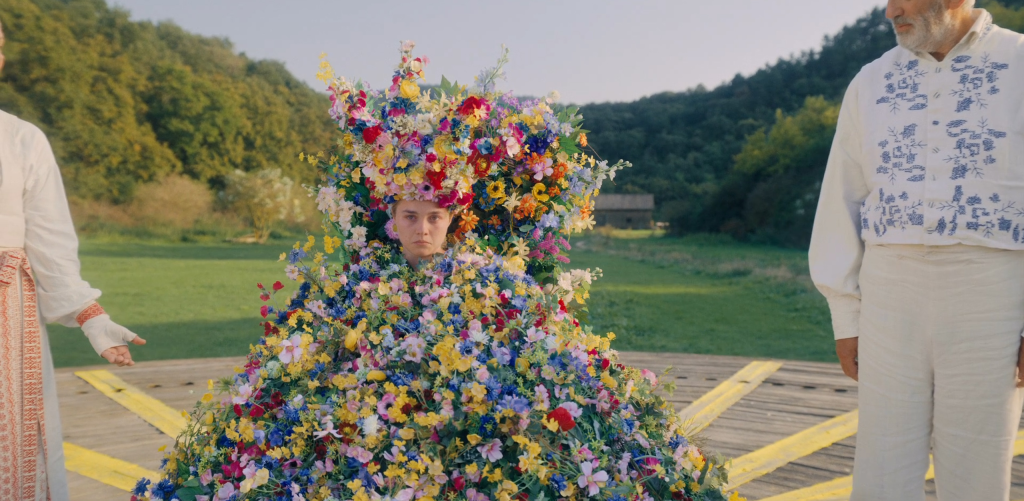
Once Dani assumes the role of May Queen, she is dressed from head to toe in a floral costume inspired by pre-Raphaelite era artwork. Andrea Flesch, the costume designer for the film did not make these connections to nature by accident. Instead, she used art to inspire Dani’s final look.
Dani’s dramatic final costume was inspired by John Everett Millais art piece, Ophelia (1851-1852) which depicts a scene from Shakespeare’s play Hamlet, where Ophelia goes to the stream to drown after the death of her father and the termination of her marriage to Hamlet. The flowers floating around her symbolize her story whereas the poppies are representative of her death. The same flowers that are seen floating around Ophelia’s dying body are the same that decorate Dani’s body.

Dani’s harmonious connections with the flowers and nature throughout the film are inspired by Leon Frederic’s painting, “The Four Seasons” (1894). This painting represents harmony between man or in this case woman, and the environment. Dani is mostly covered in St. John’s Wort, a plant used to alleviate depression, anxiety, and insomnia, all things Dani struggles with. The wildflowers from the Swedish mid-north are a combination of bluebells, symbolic of everlasting love, cornflowers (unreturned love), and forget-me-nots, representative of true love.
Dani’s harmonious connections with the flowers and nature throughout the film are inspired by Leon Frederic’s painting, “The Four Seasons” (1894). This painting represents harmony between man or in this case woman, and the environment. Dani is mostly covered in St. John’s Wort, a plant used to alleviate depression, anxiety, and insomnia, all things Dani struggles with. The wildflowers from the Swedish mid-north are a combination of bluebells, symbolic of everlasting love, cornflowers (unreturned love), and forget-me-nots, representative of true love.
This visual representation is symbolic of Dani’s blossoming into who she has longed to be, amongst her newfound community who assumes the role of her family after her losses. This growth occurs after Mark and Josh’s deaths and fully completes after she decides to sacrifice Christian. She is now able to breathe life into the Hårga commune and separates herself from Christian. She sheds the dominance that men have had over her. As she watches Christian burn in a religious yellow temple, she grins and welcomes a rebirth in herself that allows her to become one within Hårga.

Midsommar, (Aster, 2019)
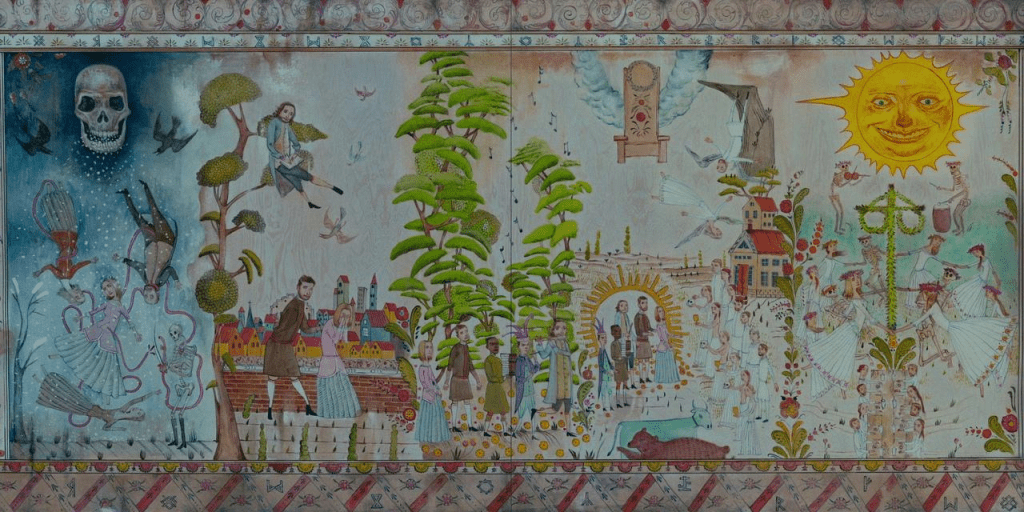
The first shot of the film literally paints a picture of how the film is going to unfold through Mu Pan’s mural. This mural then slides out to a woman humming melancholically over a dark blue forest and snowfall, a sequence that foreshadows the whole film without the audience being initially aware of it.
Indeed, the mural has four phases, just as there are four seasons of life in the Hårga life cycle. The lifecycle of Hårga starts with eighteen years of childhood (spring), eighteen years of pilgrimage (summer), eighteen years of work (fall), and finally eighteen years of being a village elder (winter).
The first phase in the mural is of one losing their family. This is the only phase that holds dark cool tones which could also be symbolic of the divide between America and Sweden. This phase shows Dani in a pink dress attached to her dead family via umbilical cord. This cord also represents the gas pipes that her sister used to kill herself and their parents.
The second phase is centered around Pelle and his plan to lure his friends to Hårga. Here he uses Dani’s traumas and relationship issues to lure her into embarking on this trip.
In the third phase, the group is shown entering the commune with musical notes, welcoming them above the trees. Mark is shown wearing a clown hat, which foreshadows his inevitable death in the commune due to his naivety. The bear at the bottom of the mural foreshadows Christian’s death at the end of the film where he is put into a bear, and both burn together. At the top of the mural, there are two elders who have reached the end of their Hårga life cycle. Both end their lives during the Attestupa, which is a Hårga tradition in which they must kill themselves by jumping off a cliff.
Finally, the fourth and final phase is of the final Midsommar tradition, where Dani dances around the maypole and is finally integrated into the Hårga commune.
The color palette in this mural is packed with warm tones. The main color of the film is yellow, often associated with feelings of happiness. In the case of this film, the color’s meaning is subverted as a color of death and suffering. This contrasts with the first phase of the mural which is blue and black, colors associated with depression and death. Ultimately, the light-yellow color in the rest of the mural is symbolic of Hårga’s perspective on death, as a beautiful and exciting part of life.
So you must wake and call me early, call me early, mother dear,
To-morrow’ ill be the happiest time of all the glad New-year;
To-morrow’ ill be of all the year the maddest merriest day,
For I’m to be Queen o’ the May, mother, I’m to be Queen o’ the May.
—The May Queen, Alfred Tennyson
Dani watches the men burn to ash and does so with a smile. A long grin that signifies the end of the patriarchy. The May Queen, in her big floral dress, watches everyone who has wronged her burn in a bright yellow temple with the rest of Hårga. She has reached the end of her journey of pleasing and living for toxic men. Now Dani is the Queen o’ the May and she will live for the fertility of Mother Nature and the wellbeing of Hårga, instead of ever having to be controlled again.
WORKS CITED
Bicakci, Matthew B. The Horror in the Making: A Feminist Film Theory and Ecomedia Studies Approach to Hereditary and Midsommar. University of Oregon ProQuest Dissertations Publishing, 2022.
Bigelow, A. Benjamin. Menacing Environment: Ecohorror in Contemporary Nordic Cinema. University of Washington Press, 2023. Chapter 5, pp. 135-163.
Goldstein, Caroline. “We Decoded All the Ingenious Art-Historical References in the Horror Movie ‘Midsommar,’ From Hilma af Klint to Judy Chicago.” Artnet News, 3 Sept. 2019, https://news.artnet.com/art-world/midsommar-art-references-1633975.
Mirabal, Marisa. “The Deadly and Restorative Application of Flowers in Ari Aster’s ‘Midsommar’.” Slashfilm, 16 Aug. 2019, https://www.slashfilm.com/568455/flowers-in-midsommar/#:~:text=During%20the%20time%20she%20assumes,the%20family%20she%20had%20lost..
Newell, C.H. “From Patriarchy to Matriarchy: Purging the Toxic Male in Midsommar.” Father Son Holy Gore, 27 July 2020, https://fathersonholygore.com/2020/07/27/from-patriarchy-to-matriarchy-purging-the-toxic-male-in-midsommar/.
O’Falt, Chris. “‘Midsommar’: How Ari Aster and Pawel Pogorzelski Created a Technicolor Fairy Tale Nightmare.” IndieWire, 3 July 2019, https://www.indiewire.com/features/craft/midsommar-cinematography-bright-technicolor-fairy-tale-ari-aster-pawel-pogorzelski-1202155560/.
Rimbaud, Arthur. “Ophelia.” PoetryNook, https://www.poetrynook.com/poem/ophelia-0.
Tennyson, Alfred. “The Lady of Shalott, and Other Poems: The May Queen”. Telebib. https://www.telelib.com/authors/T/TennysonAlfred/verse/ladyshalott/mayqueen.html
 SUBTEXT JOURNAL