Written by Markus Falk and Juniper McKenzie for Justine McLellan’s Cinema and Culture course
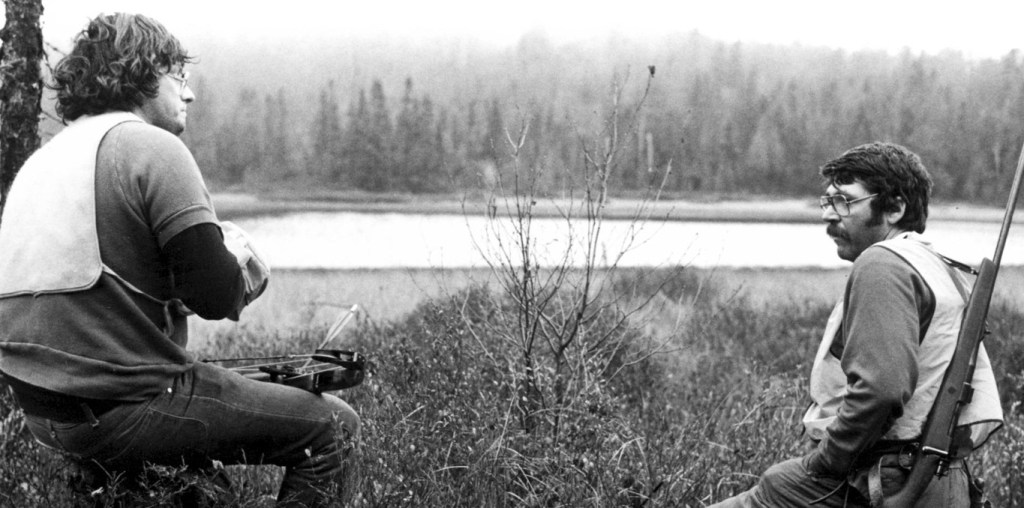
The film La Bête Lumineuse (Pierre Perrault, 1982) centers around a group of middle-aged men who go on a hunting trip in search of moose. During this trip, the social dynamics of the group, compared to that of a wolfpack, gets put under the spotlight. The tension between the masculinity of hunting and the protagonist’s, Albert, wish for intimacy and poetry leads to him getting tormented by the others. By the end of the film, his behaviour ends in a feud between him and his best friend Bernard.
Despite the film being aligned with the practices of many rural Québécois men at the time, the initial reception of the film was poor. Pierre Perrault and the Poetic Documentary discloses that “the film was taken to the Cannes Film Festival in 1983 and bombed” (Clandfield 107). Despite this initial box office flop, multiple critics of the film came back and changed their opinions, with it being viewed much more favourably. However, this initial criticism of the film stopped it from gaining more traction; possibly leading to the lack of information/analysis on the film. Yet, the themes of the film are complex and important in the scope of Québécois culture. La Bête Lumineuse artfully criticizes toxic masculinity through its use of alcohol and hunting.
An important theme in the film is alcohol, a substance that has always been a staple in Quebec’s culture. Even back in the prohibition era of Canada, “[Quebec] was the only Canadian jurisdiction to forgo a complete ban on alcohol” (Page). Throughout the film, the men of the group are often intoxicated and can be seen drinking during the day, then washing their inebriety down with more alcohol in the evenings. As described in Pierre Perrault and the Poetic Documentary, “after the ‘hunt’ comes the feasting, the verbal jousting, the horseplay, the other hunt… The drunkenness intensifies” (Clandfield 112). This is the guiding factor in creating conflict, with many altercations between the men being led by their drunkenness. The Romance of Transgression by Thomas Waugh states that “the characters drink each other towards states of utter incapacitation, matching their humiliation in the forest… with their abjection around the drinking table” (Waugh 190). This also fits into the next key theme, hunting and masculinity, as they are often inebriated while hunting.

La Bête Lumineuse (Pierre Perrault, 1982)
While the basic plot of the film is that of hunting for moose, their motives are representations of a more complex need for control and dominance over others and their environment. The book Canadian Men and Masculinities states that “the desire to exercise a degree of control over one’s life and to define oneself against perceived hostile outside forces has served as the defining feature of what it means to be a man in Quebec” (Greig and Martino 9). This is shown throughout the film, as there is nothing that fits these requirements better than hunting. It has always been deeply rooted in Quebec’s culture, with the Quebec Government’s website stating that “hunting is part of Québec’s history and has become a way of reconnecting with nature and escaping the daily grind” (Hunting in Quebec). This group of city-dwelling men seems to be trying to reconnect with this heritage, though mostly unsuccessfully as they hardly catch anything in the end.
With their surprisingly frequent sexual innuendos surrounding hunting, it is shown that it is more than just a hobby for these men: it is a means of social dominance. There is increasing tension with Albert, who is new to hunting, but wants to fit in and prove himself. However, Albert does not know how to act “manly,” and is a poet at heart. He would rather be relaxing and reciting poetry to his friend Bernard, who initially obliges before snapping at the end of the film. This fight between these best friends shows the tension between the expected idea of masculinity, and Albert’s personality. Albert faces the consequences by being humiliated and bullied by the other members of the hunting party.
Despite the group’s supposed knowledge about hunting, only one of them seems to know what he is actually doing. Barney, an Indigenous man helping guide the hunting trip, is frequently made fun of, despite clearly having much more knowledge than the rest of the group. He is much more skillful at calling moose than the others and knows the area well. However, Barney is not treated with respect and often gets teased by the others. This brings us back to the earlier discussion about the group’s need for dominance and control over their environment. While Barney is not the main subject of the film, his offhand treatment is a subtle reminder of Canada’s brutal past of “seeking to control and assimilate Indigenous peoples” (Parrott).

La Bête Lumineuse (Pierre Perrault, 1982)
Through Perrault’s direction, these serious themes present in the film are explored thoughtfully while remaining naturally funny and interesting. While the film taken at surface level might seem rough and perhaps poorly made, its use of patchy camera work and tropes similar to that of a home video make it seem more real than your typical film produced by a high budget movie studio. La Bête Lumineuse discusses topics and issues surrounding masculinity and identity through its gruff and polarizing characters, and with its deep and captivating style.
Works Cited
Clandfield, David. Pierre Perrault and the Poetic Documentary. Toronto International Film Festival, 2004.
Greig, Christopher J., and Wayne J. Martino. Canadian Men and Masculinities: Historical and Contemporary Perspectives. Canadian Scholars’ Press, 2012.
“Hunting in Quebec.” Gouvernement Du Québec, www.quebec.ca/en/tourism-and-recreation/sporting-and-outdoor-activities/sport-hunting/hunting-in-quebec.
Miller, Bill, and Steve Pennaz. “13 Reasons Quebec is the Ultimate Hunting & Fishing Destination.” Game & Fish, 1 Mar. 2016, www.gameandfishmag.com/editorial/13-reasons-quebec-is-the-ultimate-hunting-fishing-destination/190248.
Page, Julia. “From Bootleggers to the SAQ — How Prohibition Shaped the Way Quebec Drinks.” CBC News, 30 Dec. 2020, www.cbc.ca/news/canada/montreal/quebec-history-with-prohibition-1920-1.5851379.
Perrault, Pierre, director. La Bête Lumineuse. Office national du film du Canada, 1982.
Parrot, Zach, and Michelle Filice. “Indigenous Peoples in Canada.” The Canadian Encyclopedia, 11 Jan. 2023, thecanadianencyclopedia.ca/en/article/aboriginal-people Waugh, Thomas. Romance of Transgression in Canada: Queering Sexualities, Nations, Cinemas. McGill-Queen’s University Press, 2006.
 SUBTEXT JOURNAL