
By Angélique Babineau, written for Magdalena Olszanowski’s Ecocinema class
Nomadland (2020), set in 2011 Nevada, Arizona, South Dakota, and California, is an independent American drama directed by Chinese filmmaker Chloe Zhao. Adapted from the 2017 novel by Jessica Bruder of the same title, Nomadland mostly features real nomads as fictionalized versions of themselves (Linda May as Linda, Charlene Swankie as Swankie, and Bob Wells as Bob Wells).
The film follows Fern (Frances McDormand), a sixty-one-year-old woman, who loses her job after the US Gypsum factory in Empire, Nevada closes. Recently widowed, Fern finds herself alone on the road, with nothing but her van. As she travels through the American West in the hope of finding employment, she must adapt to the life of a modern-day nomad – someone without a fixed address who travels from place to place. Making friends and reuniting with family, her perception of belonging and identity slowly starts shifting.
Through its cinematography and shot composition, Nomadland defies the traditional utopic depictions of nature in Hollywood ecocinema films by exhibiting the contrast between the beauty of the landscape and the harshness of living minimally within it. While American cinema tends to objectify wilderness as an exotic, separate identity, Nomadland strays away from said conventions, depicting Fern as she is forced to embrace life connected to nature. However, the film also carefully removes itself from idealistic neo-primitivism, a concept Sophie Christman Lavin and E. Ann Kaplan, professors of English at Stony Brook University, define as the return “to simple, sustainable lifestyles within or close to the natural world” (Christman Lavin and Kaplan).
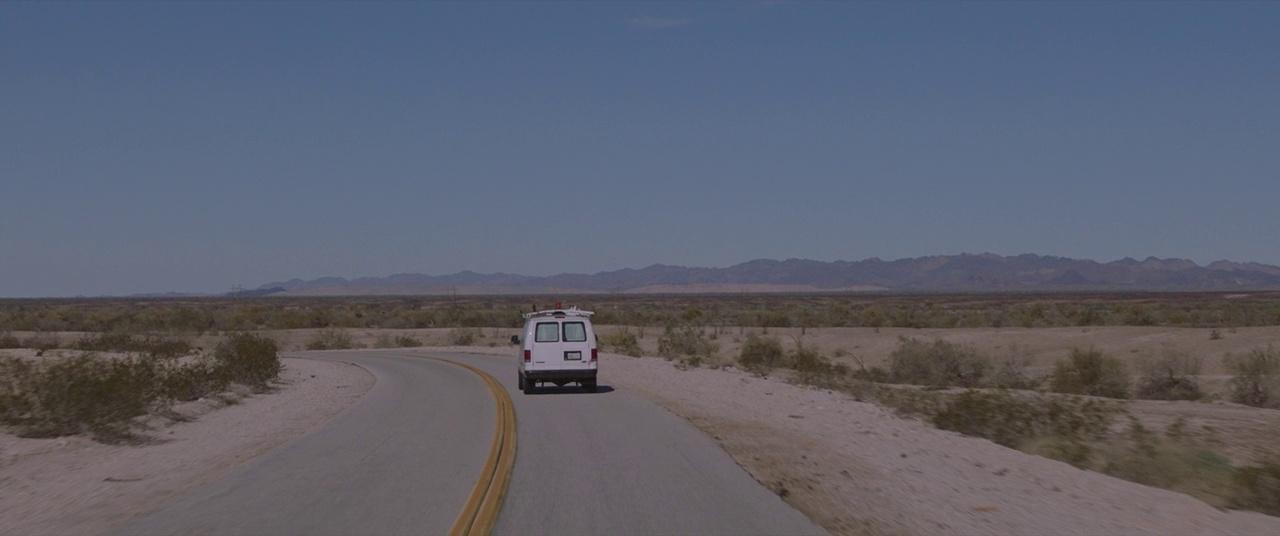
Nomadland (Zhao, 2020)
This is emphasized by the film’s cinematography, which presents life as a nomad, albeit an arguably more sustainable way of life, as challenging. The dichotomy of nature as both mesmerizing and brutal is illustrated through long deep focus shots of Fern adapting to the natural environment. At the beginning of the film, Fern, newly nomadic, is depicted as she goes to the bathroom in a field (Zhao 00:02:54 – 03:28). The background of Nevadan mountains is still, contrasting with Fern’s visibly uncomfortable small silhouette. Looking around afraid to be caught by a passerby, the situation is obviously not ideal for Fern. Moreover, the mixtures of contemplative shots where Fern is thriving in nature, juxtaposed with rapid and brief clips of Fern’s mundane, repetitive, and at times, lonely workplace and daily life (Zhao 01:32:00 – 33:55), offer a nuanced perspective that deconstructs Western neo-primitivism rooted in utopian wilderness ideologies. Nomadland argues that life in harmony with nature, although possibly fulfilling, is not simpler, easier and nor does it make all ill disappear.
Through Zhao’s unique directorial lens, Nomadland confronts the conventional “[white] men against nature” trope of some mainstream ecocinema films both in the story itself and in the team behind the production. The film relates to Doreen Massey’s concept of “people in parentheses” (Mahoney 170). Zhao, growing up in China and observing America through an outsider’s lens, brings a different perspective to ecocinema, allowing the voices of those left behind to be heard (Zhu). Nomadland focuses on an older, nomadic widowed woman, a type of character often invisible in typical narratives. Although forced into nomadism due to unforeseen circumstances, Zhao gives Fern control over her environment; she is able to explore the mysteries and dangers of nature analogous to the way (white) men usually do on screen. When Fern is offered to stay at Dave’s son’s house for the night, she initially accepts but eventually chooses to sleep outdoors. At night, Fern returns to her van, where it is colder and less comfortable (Zhao 01:29:47 – 01:30:26). Nonetheless, Fern regains agency over her environment, redefining the meaning of home and belonging. Inside the house, she is alienated, constricted to the limits of the man-made, and shot in wide angles surrounded by the emptiness of the rooms (Zhao 01:31:06 – 31:40). Outdoors in her van, she flourishes, echoing what she said to her ex-tutee at the beginning of the film, she is “not homeless, just houseless” (Zhao 00:10:12 – 10:19).

Nomadland (Zhao, 2020)
Nomadland departs from similar ecocinema films, namely Grizzly Man (Herzog, 2005) and Into the Wild (Penn, 2007), in that it does not portray nature as a force to conquer nor does it depict living on the margins of society as a simple gateway from modern life. With an ambiguous ending, Nomadland does not end on a note that illustrates the triumph of nature over “man,” but rather suggests that, while arduous, living in connection with nature is achievable. For movies with similar thematic, consider viewing Jean-Marc Vallée’s Wild (2014), Debra Granik’s Leave No Trace (2018), or Chloe Zhao’s directorial debut Songs My Brothers Taught Me (2015).
Works Cited
Christman Lavin, Sophie, and E. Ann Kaplan. “The Climate of Ecocinema” [Abstract]. Oxford Research Encyclopedia of Communication, Aug. 2017, doi.org/10.1093/acrefore/9780190228613.013.121.
Herzog, Werner, director. Grizzly Man. Discovery Docs and Lionsgate, 2005.
Mahoney, Elisabeth. “The People in Parentheses.” The Cinematic City, Routledge, 1997, pp. 169-186.
Penn, Sean, director. Into the Wild. Paramount Vantage, 2007.
Zhu, Ying. “’Nomadland’: An American or Chinese Story? Review of ‘Nomadland’ (Chloe Zhao, 2020).” Global Storytelling: Journal of Digital and Moving Images, vol. 1, no. 2, Winter 2022, doi.org/10.3998/gs.1706.Zhao, Chloe, director. Nomadland. Highwayman Films, Hear/Say Productions, and Cor Cordium, 2021.
 SUBTEXT JOURNAL