
By Emilia Martinez-Zalce Darroch, written for Justine McLellan’s Explorations in Cinema and Communication
“I would be complex / I would be cool / They’d say I played the field before I found someone to commit to / And that would be okay for me to do / Every conquest I had made would make me more of a boss to you.” These lyrics are from “The Man,” a track from American singer-songwriter Taylor Swift’s seventh studio album Lover. Whether you love her or hate her, it is indisputable that Taylor Swift has been one of the most popular music stars for well over the past decade. Despite her massive success within the music industry, she has faced massive backlash and criticism regarding virtually every aspect of her life. Taylor Swift’s career encompasses the hypocrisy within Western media, notably so within her feuds and personal relationships.
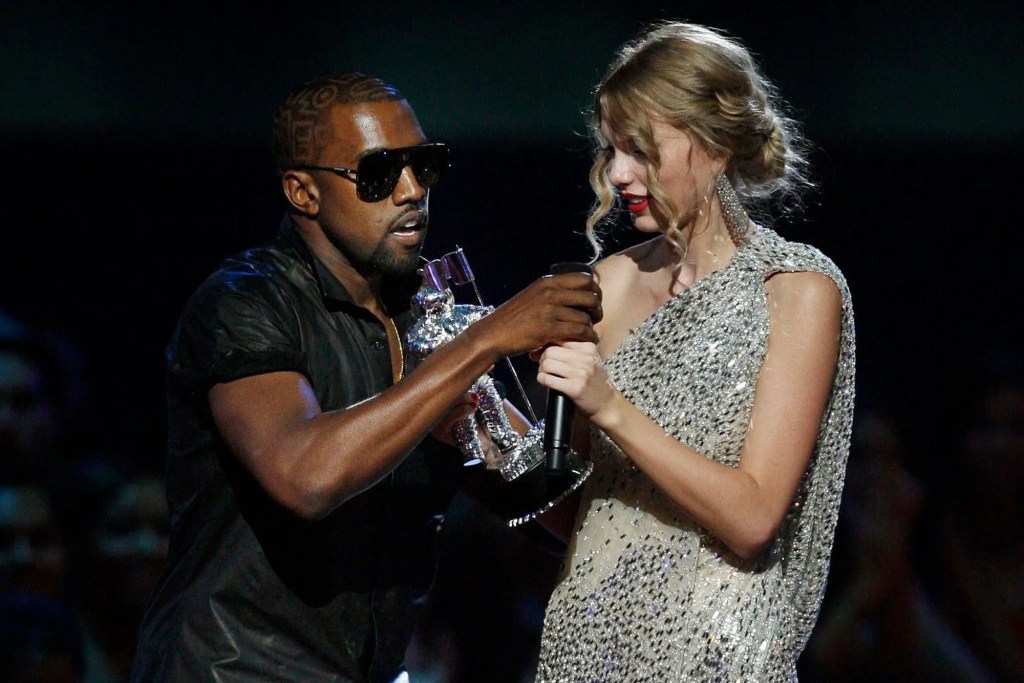
An analysis of recent tabloids quickly leads to the conclusion that male celebrities tend to receive more positive press than their female counterparts in the matter of interpersonal problems. This is exemplified by the long-running feud between Kanye West and Taylor Swift. At the 2009 MTV Video Music Awards, a 19-year-old Taylor Swift was delivering her acceptance speech after receiving “Best Female Video” for her hit single “You Belong With Me.” Kanye West interrupted her to announce to the audience that “Beyoncé had the best video of all time” (“A Complete Timeline”). This was a defining moment in the celebrity gossip culture of the 2000s and while it sparked outrage, it equally created mockery. West was painted as the humorously bold rapper, while Swift was cast as the defenseless victim. Despite a majority of viewers empathizing with Swift, numerous reporters claimed it only added to Swift’s victim-complex association, which is part of a long-standing gender and cultural stereotype – the doe-eyed blonde. In 2010, Swift wrote the song “Innocent” not only as a response to what happened with West, but to address the media coverage she received following the situation. Swift debuted the song at the VMAs the following year. Writing about the performance, Ellie Woodward, a reporter for BuzzFeed, went as far as to say, “[…] the scene was edited to entirely omit West’s infamous line, and the final shot lingered on her overly painted face” (Woodward). This reporter not only criticized Swift for expressing herself on an impactful event that was outside of her control, but unnecessarily commented negatively on Swift’s appearance to solidify her argument, suggesting the singer was wearing a mask as if she were hiding her real self. Kanye West is infamous for his feuds with many other male celebrities, including Canadian rapper Drake. NME, a pop culture blog and magazine, focused on a neutral fact-based approach: “Earlier this month, [Kanye] extended an olive branch to Drake and invited him to appear at a forthcoming Los Angeles show on December 9th” (Langford). This demonstrates how mainstream media tends to characterize conflicts between male public figures as signs of passionate, bold, and outspoken natures, whereas female figures are portrayed as scheming, calculated, and manipulative. These tendencies mirror general sexist characterizations of gendered stereotypes, avoiding discussions of why such contrast exists within the entertainment industry as well as how it is (in)validated distinctly for individuals based on their gender.

Male celebrities are commonly celebrated for numerous high-status relationships, while female figures are “slut-shamed” by the media for similar behavior. This is exemplified by the continuous backlash Taylor Swift receives regarding her dating life. Since a majority of her songs are about romantic relationships and often biographical, Swift herself has brought attention to her love life in the public sphere. In one of her more public affairs back in 2012, Swift dated Harry Styles, an extremely popular teen music star. The relationship was short-lived, but caused a whirlwind of the press. Despite both celebrities having indiscreet romantic lives, Swift received much more negative press.In 2021, Seventeen published an article celebrating Harry Styles’ numerous “conquests”:
“[He] has been in the public eye for years, and he has been a heartthrob the whole time. So, it’s no surprise that his list of exes is about as long as a CVS receipt and includes models, actresses, and more models” (Twersky).
Styles’ behavior is cast as normal, while female figures like Swift are not painted so kindly, cast as clingy, obsessive, opportunistic, and déclassé for having dated many people. This demonstrates that male celebrities are celebrated by the press for “womanizing” and engaging in numerous sequential affairs. If a man’s personal life emerges in their art, such as a biographically inspired song, video, or story, it is just part of the romantic bohemian lifestyle. In an article for Vanity Fair, a reporter stated: “Swift writes songs about the guys she dates and then sends fans on a scavenger hunt to find out who they are” (Sales). Criticism is something to be expected from the media regarding celebrities who use their personal lives to create public art. It is completely valid to dislike Swift or other female stars as long as it is not rooted in misogyny. However, these quotations criticizing Swift read like opinion pieces or character assassinations, but are meant to be celebrity news reports. The challenge needs to be made to end subjective storytelling practices rooted in sexist assumptions of how people should or should not behave.
Despite Western media claiming to be progressive and supportive of feminism, it frequently punishes female figures who attempt to take control over their name, reputation, and working conditions. Using popular “girl power” feminism language, the media has jumped on the performative bandwagon by encouraging women to “girl boss” their way through life. Yet, when women attempt to reclaim ownership of their assets and reputation, they are shamed. In 2013, Taylor Swift was groped by David Mueller, a radio DJ. Swift made allegations of the assault public, but Mueller sued her first, claiming Swift’s allegation cost him his job. Swift “only asked for a symbolic $1 in damages from Mr. Mueller and has now pledged to donate to organizations that help defend sexual assault victims” (“Taylor Swift Sexual Assault Case”). Despite her win in court, she was criticized by many for ruining David Mueller’s life. This echoes the criticism many victims received during the MeToo movement. This movement originated as a campaign in which many celebrities, notably female actresses, spoke out about the sexual abuse they faced throughout their careers. This movement was meant to re-empower victims of sexual assault, but received criticism for creating an environment of fear for men in the workplace, afraid they’d be “metoo’d” (i.e.: falsely accused of sexually harassing a woman). Despite tabloids “encouraging” feminist values, when a woman tries to reclaim her power, she is frequently depicted as vindictive or greedy.

There is a strong double standard in the treatment of male and female celebrity figures. Fortunately, press coverage is not the only factor within a public figure’s reputation. For better or for worse, social media does allow for immediate connection with audiences, allowing female artists and fans to publicly defend and deconstruct these double standards. Artists like Taylor Swift work to empower themselves through unapologetically reclaiming their narrative. As Swift herself puts it, “Other women who are killing it should motivate you, thrill you, challenge you, and inspire you.”
Works Cited
“A Complete Timeline of Kanye West & Taylor Swift’s relationship.” Billboard, 24 Mar. 2020, www.billboard.com/music/music-news/kanye-west-taylor-swift-relationship-timeline-6686064/#.
Langford, Jackson. “Kanye West and Drake Finally Reunite after Seemingly Ending Their Feud.” NME, 17 Nov. 2021, www.nme.com/news/music/kanye-west-and-drake-finally-reunite-after-seemingly-ending-their-feud-3097151.
Sales, Nancy Jo. “Taylor Swift’s Telltale Heart.” Vanity Fair, 15 Mar. 2013, www.vanityfair.com/hollywood/2013/04/taylor-swift-cover-story.
Swift, Taylor. “Innocent” Speak Now. Big Machine Records, 2010. Spotify, open.spotify.com/album/5MfAxS5zz8MlfROjGQVXhy?si=I4CsNYTbTomgupASwSJHKw.
Swift, Taylor. “The Man.” Lover, Republic Records, 2019. Spotify, open.spotify.com/album/1NAmidJlEaVgA3MpcPFYGq?si=_WK4Cgh2R4Se7zHxdw1v1A.
Swift, Taylor. “You Belong With Me.” Fearless, Big Machine Records, 2008. Spotify, open.spotify.com/album/1rwH2628RIOVM3WMwwO418?si=Z6CMbrJlR8a–iYf0I-hIA.
“Taylor Swift Sexual Assault Case: Why Is It Significant?” BBC, 15 Aug. 2017, www.bbc.com/news/entertainment-arts-40937429.
Twersky, Carolyn. “Check out This Complete Guide to All of Harry Styles’ Past Relationships.” Seventeen, 14 Oct. 2021, www.seventeen.com/celebrity/celebrity-couples/a22603190/harry-styles-girlfriends-dating-history/.
Woodward, Ellie. “How Taylor Swift Played The Victim for a Decade and Made Her Entire Career.” BuzzFeed, 17 Dec. 2018, www.buzzfeed.com/elliewoodward/how-taylor-swift-played-the-victim-and-made-her-entire-caree.
 SUBTEXT JOURNAL