Written by Lou Tremblay, written for Justine McLellan’s Explorations in Cinema and Communications
Winner of the Cheryl Simon Writing Award for Subtext’s Fall 2023 issue
It is a well-known fact that the horror genre has not been particularly kind to women. In the past, horror films often have offered tropes, such as the “Final Girl” or the “Damsel in Distress” tropes, that seem to shame and belittle women. However, in the last few years, women filmmakers have started to reclaim the horror genre to represent the anxieties and fantasies that often come with womanhood. Concepts and themes like the monstrous feminine or sexuality have started to hold an important place in these women’s films. There are many that offer this new perspective of women in horror, but three films have already claimed their cult classic status: Jennifer’s Body (Kusama, 2009), Raw (Ducournau, 2016), and A Girl Walks Home Alone at Night (Amirpour, 2014).
Jennifer’s Body
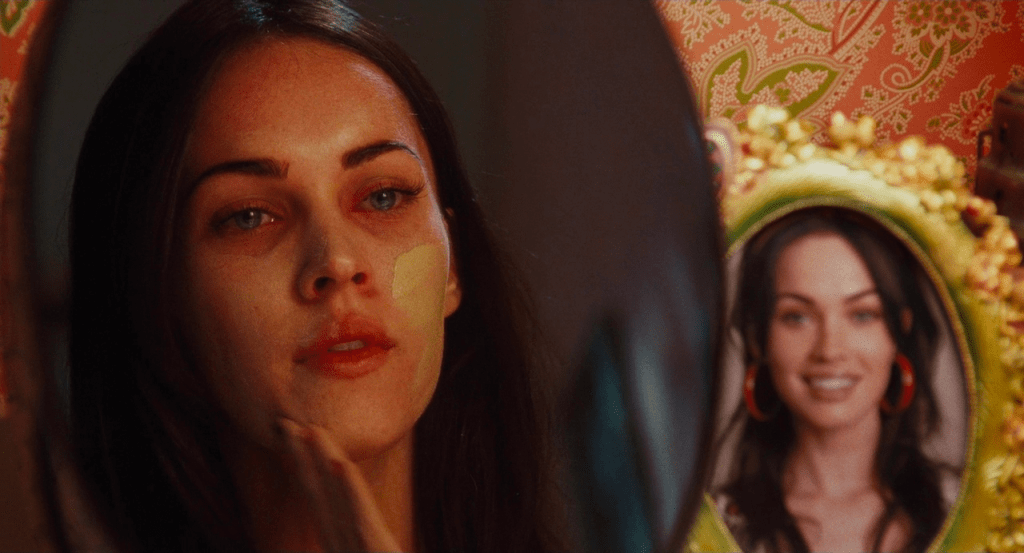
Jennifer’s Body (Kusama, 2009)
Firstly, Jennifer’s Body is a 2009 dark comedy horror film directed by Karyn Kusama and written by Diablo Cody. The film centers around Jennifer, a student, as she gets possessed following a traumatic event and begins to kill and eat her male classmates. The film had a terrible reception when it first came out, due to the misleading marketing that promoted it as a sexy horror movie, because of the casting of Megan Fox as Jennifer, made for straight teenage boys. However, Jennifer’s Body did something that many horror films at the time didn’t: it offered an interesting perspective into rape culture and deviated from certain horror tropes. In Meaghan Allen’s essay “Her Body, Herself Rape-Revenge and the Desire for Catharsis,“ she explains this perspective: “Jennifer’s Body is about Jennifer the person coping with her extreme violation by using her sexuality to trap and consume those who once ‘consumed’ or objectified her body” (Allen 3). Many critics would describe Jennifer’s Body as a fantasy for straight men, when in fact, it was a fantasy for women who suffered from the objectification and the sexual violence of men (Grady). The film also criticizes many film tropes. Usually, in many classic horror tropes, purity and virginity are praised with tropes such as the “Final Girl.” Jennifer’s sexuality, however, isn’t a weakness but one of her strengths (The Take 00:05:20).
Raw

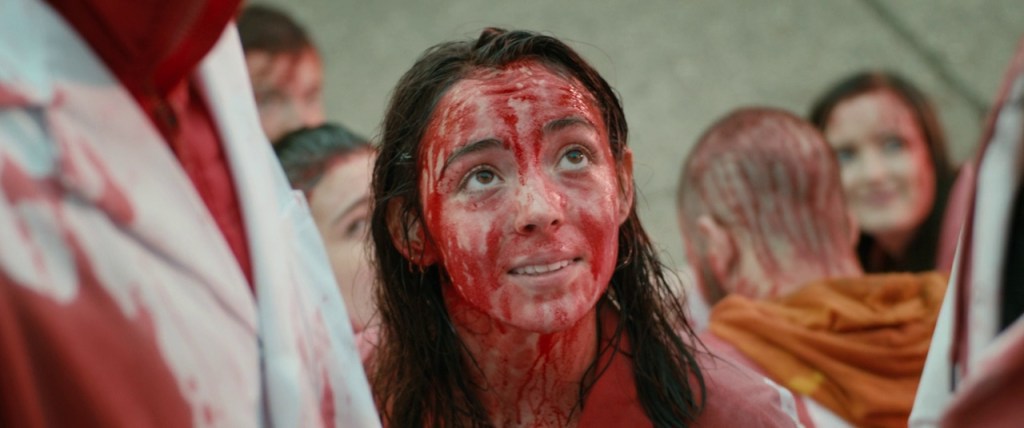
Raw (Ducournau, 2016)
Secondly, the 2016 French film Raw directed and written by Palmes d’Or winner Julia Ducournau is a body horror film that also, through its violent imagery, explores feminist themes. The story revolves around Justine, a teenage girl from a vegetarian family, as she goes to veterinary school and is forced to eat raw meat for the first time. This leads to her craving of human flesh. The cannibalism in the film is used as a metaphor for Justine’s sexual awakening. The film explores sexuality in an interesting way as it shows how she tries to hide and bury her sexual feelings, which is shown in the film through her cannibalistic urges. Female sexuality has always been seen as taboo on screen. It is rare to see a healthy portrayal of it, especially with teenage girls, even in modern day media. In the Dazed article “Is Female Sexuality Taboo on Screen?” written by Alex Denney, director Carol Morney explains why it is so taboo: “Girlhood, and young female sexuality, has been so colonized by certain images and an unhealthy dose of voyeurism that it can become uncomfortable viewing, so it’s important that female directors and directors of photography get more chances to present insights into female subjectivity” (Denney). Raw is then an exploration and a visual showing of the fears of female sexuality and how much it can affect young girls.
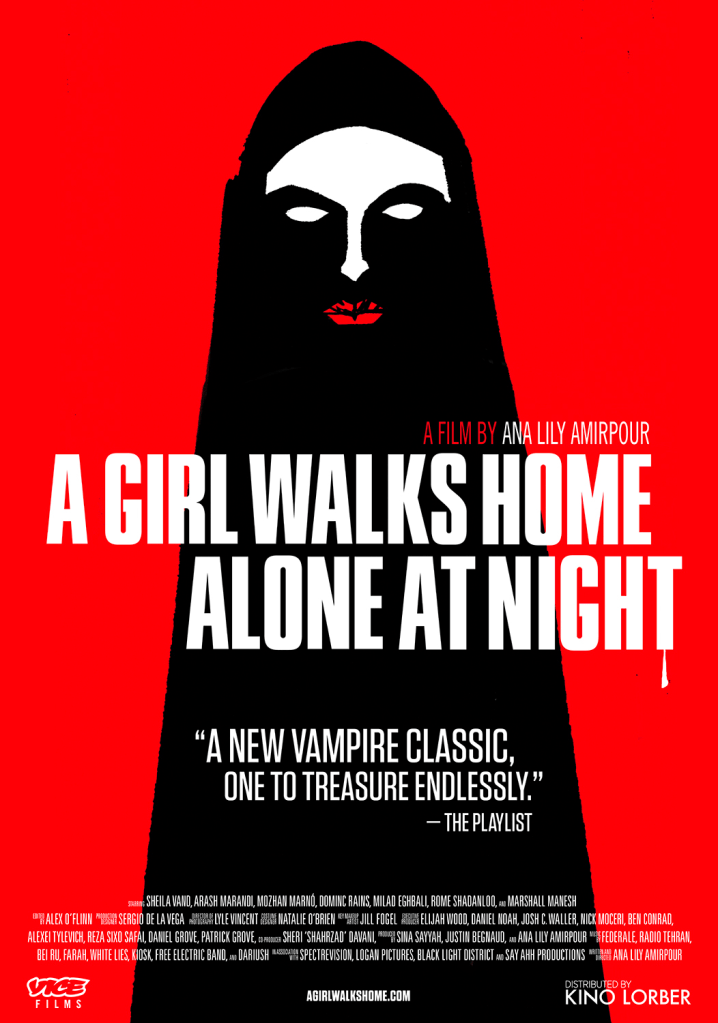
A Girl Walks Home Alone At Night
Thirdly, Ana Lily Amirpour’s 2014 horror romance film A Girl Walks Home Alone at Night also offers a female fantasy. In the story, a lonely vampire stalks the people of an Iranian ghost town called “Bad City” and explores the development of her relationship with a man called Arash. One of the many things explored with the film is the concept of the monstrous feminine. This term was coined by Barbara Creed in her book of the same name. It explores the reversal of women as victims in horror films to women as monsters and how it often uses monsters that reflect female sexuality. In A Girl Walks Home Alone at Night, that monster is the vampire. Like Creed mentions in her book, the monstrous feminine is also linked to abjection:
Although her study is concerned with psychoanalysis and literature, it nevertheless suggests a way of situating the monstrous-feminine in the horror film in relation to the maternal figure and what Kristeva terms ‘abjection’, that which does not ‘respect borders, positions, rules,’ that which ‘disturbs identity, system, order’. (Creed 8)
Ana Lily Amirpour portrays this abjection with her female vampire character in the film as she feels alone in her abnormality and monstrosity. The film also explores a fantasy that all women have: the ability to, like the title of the film says, walk home alone at night. Throughout the film, we see the main female character roaming through the streets without a care in the world. She explores the ghost town and instead of fearing danger, she instills fear in others. In situations with predatory men, because she is a vampire, she is able to defend herself, something that a lot of women can’t do in reality. In conclusion, Jennifer’s Body, Raw, and A Girl Walks Home Alone at Night are films that showcase many feminist ideas, anxieties, and fantasies through their use of horrific imagery and concepts. These movies are proof that women filmmakers can bring new and important voices to cinema that male filmmakers are not necessarily capable of. While many still don’t recognize women’s talent in film, their voices are slowly being listened to which we can see in recent award shows like the Academy Awards with Chloe Zhao’s Nomadland (Zhao 2020) and the Cannes Festival with Julia Ducournau’s Titane (Ducournau 2021).
 SUBTEXT JOURNAL